

Python Developer Roadmap: A Practical Learning Sequence
Use a staged Python learning plan that connects fundamentals, projects, data and backend work.
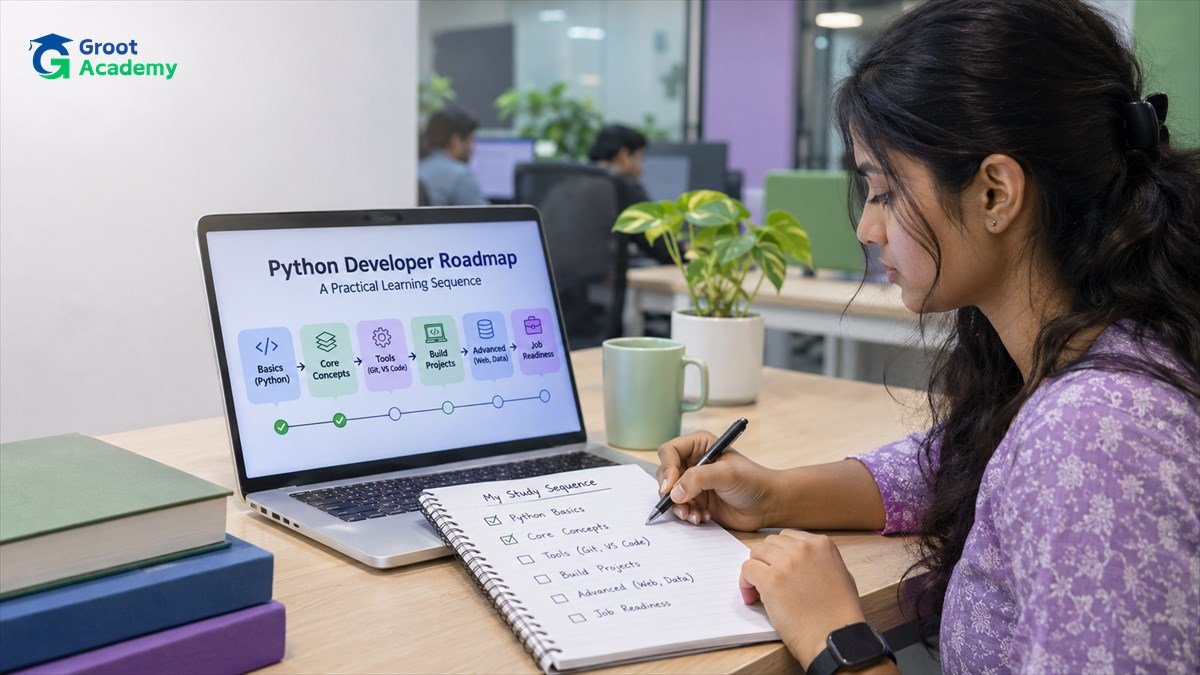
A useful Python learning sequence
A roadmap is a way to choose the next practice task; it is not a promise that every learner needs the same tools. Start with core language concepts, use them in small programs, then choose a direction based on the problems you want to solve.
- Learn syntax, values, control flow, functions and files.
- Practise logic with small, testable exercises.
- Use collections, modules, exceptions and object-oriented design when they make a program clearer.
- Connect a project to data, an API or a user interface.
- Document the work and review the next gap.
Build foundations before frameworks
Variables, strings, lists, dictionaries, conditions, loops and functions give you the vocabulary to solve a problem. Practise by reading input, validating it, transforming data and explaining the result. Data structures and algorithms are useful as reasoning tools: choose a representation, define the expected output and check normal and invalid cases.
Object-oriented programming can help organize related state and behaviour, but it is not a requirement for every small script. Prefer simple, understandable functions until a larger model gives a clear benefit.
Use projects to connect concepts
After the foundation, make a small project with fictional data: a task tracker, expense summary, library catalogue or course-enrollment model. Add persistence only when you can explain the records and their relationships. For backend practice, connect a Python service to a documented API boundary and test responses, errors and permissions.
The REST API guide explains requests and responses; the maintained Python course provides a structured topic path.
Choose a direction after the core
| Interest | Next practice |
|---|---|
| Backend applications | HTTP, validation, data models, tests and deployment concepts. |
| Data work | Cleaning fictional datasets, analysis and clear visual communication. |
| Automation | Repeatable scripts, safe file handling and useful logs. |
| AI applications | Python foundations, data handling, evaluation and responsible review. |
Record work honestly
Keep a short README for each project: its goal, fictional data or inputs, setup, checks performed and limitations. A repository is useful when it explains your contribution rather than only collecting unrelated exercises. See the GitHub portfolio guide.
Frequently asked questions
Should I learn data structures before building projects?
Learn basic collections early, then alternate focused problem practice with projects so each reinforces the other.
Do I need every Python framework?
No. Build a foundation and choose a tool when a project need makes its role clear.
Start with Python foundations
Build concepts through small, tested programs before moving to frameworks or specializations.
Explore Python Programming