


Java Full Stack Roadmap 2026: Build One Complete Web App
Connect browser fundamentals to a Java backend, database and tested deployment through one portfolio project you can explain end to end.
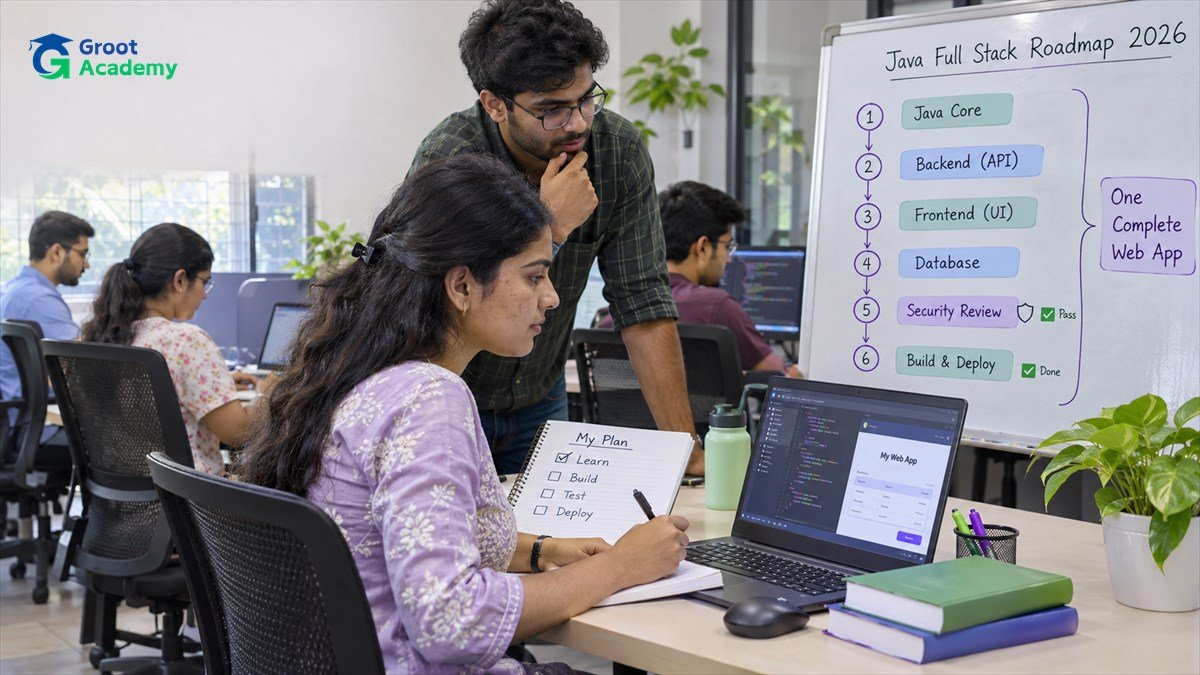
What does Java full stack cover?
Reading an older roadmap? The source-checked 2018 retrospective explains what the release timeline actually supports and which foundations still matter.
A Java full stack application has a user-facing interface, a backend that handles rules and requests, and data storage. A learner should understand how a user's action travels from the browser to an API, through the Java application, into a database and back to the screen. Knowing a list of tool names is less useful than being able to build and explain that complete flow.
This 2026 roadmap uses one small project to connect the layers. It is a learning sequence, not a fixed timeline or a claim that every employer uses the same frontend framework. Check any course's current syllabus and the versions it teaches before enrolling.
Begin with browser fundamentals
Learn semantic HTML for page structure, CSS for responsive layout and JavaScript for interactions. Build a course catalogue page that works on a narrow phone screen as well as a desktop. Add a form and display useful validation messages. Use the browser's developer tools to inspect network requests and layout problems. MDN's first website learning path covers these foundations.
Only after you can build and debug a small page with plain JavaScript should you add a component library or framework. React is one option for a richer interface. Its official learning guide introduces components, props, state, events and rendering lists. Practise those concepts by splitting the catalogue, filters and enrolment form into components. Do not hide an unclear data flow behind more libraries.
- Make buttons and forms usable with a keyboard, and label every input.
- Show loading, empty and error states rather than only the successful screen.
- Keep API URLs and environment settings separate from display components.
Build the Java backend in layers
Before Spring Boot, practise classes, collections, exceptions, SQL and HTTP concepts. The Java programming guide covers that foundation. Start a small Spring Boot application with one resource, such as a course. For the current Java 27 and Spring Boot 4.1 compatibility matrix, see the 2027 backend compatibility roadmap. Define what a request may contain, what the response should look like and which errors a client should see. The official first application tutorial shows a supported way to create a small web application.
Separate request handling from business rules and persistence so you can test each responsibility. Add a relational database after the in-memory version works. Model courses, learners and enrolments, then decide which fields must be unique and which records may be changed. Spring Data JPA's repository documentation explains the data access abstraction; it does not remove the need to understand SQL and the underlying data model.
Learn the difference between authentication, which identifies the requester, and authorization, which determines permitted actions. Keep credentials out of source control. Add access rules only after the basic application flow is working and you can test who may read, create or cancel an enrolment.
Connect the browser, API and database
To practise the backend slice in detail, follow the Spring Boot booking API project roadmap and test its success, validation and concurrency cases.
Write down a small API contract before connecting the frontend: a course list, one course detail and an enrolment action are enough to start. Decide which fields the client sends and which the server owns. The browser should show a helpful message for validation errors and a retry path for temporary network failures. Test a failed request as deliberately as a successful one.
Use the browser network panel to confirm the request URL, method, body, status and response. If the frontend and backend run on different origins during development, configure cross-origin access deliberately for the expected origin; do not treat a broad wildcard as a substitute for understanding the browser's rules. Keep production configuration separate from local development settings.
Build one end-to-end vertical slice first: display a course, submit an enrolment and show the saved result. Then add search, filters or account features. This order reveals integration mistakes early, while the project is still small.
A portfolio project that demonstrates the complete flow
A workshop booking application is a manageable capstone. Visitors can browse workshops and request a seat; an administrator can see registrations. Begin with a short statement of the rules: what counts as an available seat, whether duplicate bookings are allowed and how cancellation works. These decisions matter more than adding many screens.
- Sketch the mobile and desktop screens and identify the data each screen needs.
- Design the database tables and API responses before building the full interface.
- Build the smallest browser-to-database flow, then add validation and error handling.
- Test an empty catalogue, a full workshop, duplicate registration and an invalid request.
- Document setup, environment variables, example requests and the decisions you made.
Show the project in a portfolio only when you can run it, explain its data flow and identify at least one improvement you would make next. That explanation is more useful than an inflated feature list.
Test, review and release the app
Use focused tests for booking rules and API responses. Check that a database error does not expose secrets to the browser. Run the app with production-like configuration before deployment and verify logs, links and a basic health check afterward. The exact hosting approach depends on the selected course and project; do not assume every Java service requires a microservices architecture.
For a wider comparison, read the full stack career guide. For backend depth, use the Spring Boot beginner roadmap. Groot Academy's Satnam Singh faculty profile provides Java backend mentor context; confirm the current Java full stack teaching team and batch details with the academy.
Frequently asked questions
Must I learn React to become a Java full stack developer?
No single frontend framework defines the role. Learn HTML, CSS, JavaScript and browser APIs first. React is one possible next step if the course or project uses it.
Should I learn SQL before Spring Data JPA?
Yes, basic SQL helps you design tables, understand queries and diagnose persistence problems even when a repository abstraction writes much of the access code.
How many projects do I need to start?
One small, finished application that connects the frontend, API and database is a useful starting point. Add another project when it demonstrates a genuinely different skill.
Explore Java full stack retrospectives by year
This page is the practical current learning path. The dated retrospectives below help explain how Java, Spring and frontend release choices changed over time; each is explicitly written as a later look back, not as a post published in its historical year.
- Earlier foundations: 2014: Java 8, Spring Boot 1.0 and early React; 2015: Spring Boot DevTools and React 0.14; 2016: Spring Boot 1.4 testing and React 15; 2017: Java 9 modules, Spring milestones and React 16.
- Framework transitions: 2018: Spring Boot 2 and JDK 11 chronology; 2019: Java 11/12, Spring Boot 2.2 and React Hooks; 2020: app development through deployment; 2021: testing the whole flow; 2022: the Spring Boot 3 bridge.
- Recent releases: 2023: the Spring Boot 3 transition; 2024: Java virtual threads and React 19 chronology; 2025: Java 25 and Spring Boot 4.
For a current backend version check rather than a historical overview, see the 2027 Java 27 and Spring Boot compatibility roadmap.
Version-aware official references
For recent version-history context, read the 2025 Java full stack retrospective, which covers the Spring Boot 3.5 to 4 transition and Java 25. Use MDN Web Docs for browser fundamentals, React's official guide if React is part of your frontend, and the Spring Boot documentation for your installed backend version. Recheck version requirements when tooling changes.
Explore a Java full stack learning path
Compare the current Java Full Stack Development course syllabus, project scope, prerequisites and batch options in Jaipur.
View Java Full Stack Course