

Java Full Stack Roadmap in 2016: Spring Boot 1.4 and React 15
A source-checked look back at Java, Spring Boot 1.4 and React 15 in 2016, with a learning sequence centered on testing the complete application flow.
Why revisit a 2016 Java full stack roadmap?
This article was written on November 13, 2026. It is a retrospective based on dated release records, not a post published in 2016 or a claim about a particular academy's syllabus. The useful question is not which stack was universally best, but what a learner could reasonably practise and how to recognize old version-specific advice.
Read the 2014 retrospective for the earlier Java 8 and Spring Boot 1.0 context, and the 2015 retrospective on Boot DevTools and React's package split for the late-2015 workflow changes. This guide focuses on a more practical shift in Spring Boot 1.4: its dedicated test support and more convenient slices for checking parts of an application.
What changed in the Java full stack landscape in 2016?
Java 8 was the established language baseline for many learning examples by this point. A Java web learner could practise object-oriented design, collections, exceptions and tests without needing to adopt every new tool announced during the year. The language foundation and the browser-to-database flow mattered more than a long framework checklist.
Spring Boot 1.4 reached general availability on July 28, 2016. Its release highlighted a substantial testing update, including a unified @SpringBootTest annotation, and focused test annotations such as @JsonTest, @WebMvcTest, @RestClientTest and @DataJpaTest. The release also described startup failure analysis, which could turn some common configuration mistakes into more actionable messages. These are historical capabilities of that release line, not a recommendation to start a new system on an unsupported version.
React 15.0 was released on April 7, 2016. The React team's release notes describe changes to DOM rendering and note that React would no longer actively support Internet Explorer 8. React was one possible frontend for a Java service, not a required part of a Java full stack curriculum. Server-rendered Java pages and other JavaScript approaches remained valid alternatives.
A practical learning sequence for that period
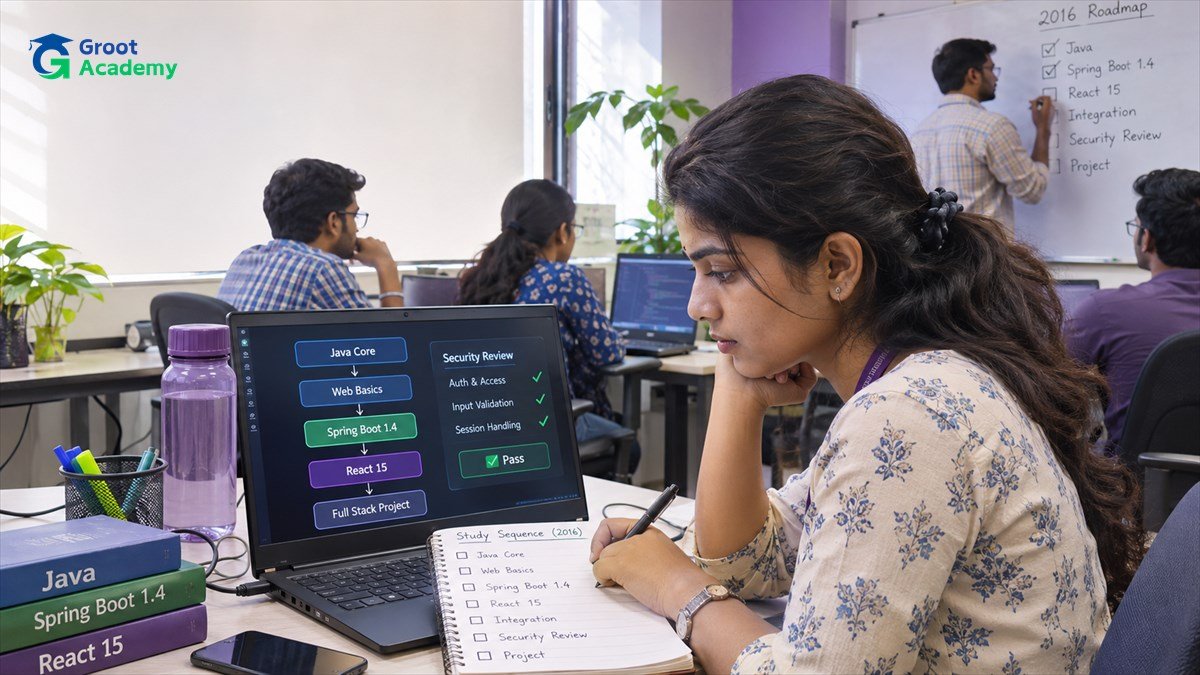
- Start with the browser: build a responsive page using HTML and CSS, then add JavaScript form validation and inspect the HTTP request and response.
- Learn Java fundamentals: practise classes, interfaces, collections, exceptions and small unit tests. Make each method's input, output and failure cases clear before introducing a framework.
- Design the data: create a small relational schema, write SQL queries and understand keys, joins and transactions. Check what should happen when a save fails or two users request the same item.
- Add a backend: build a Java web application and learn how routes, validation, business rules and database access fit together. Spring Boot 1.4 was one available approach during the latter part of 2016.
- Test at the right boundary: test a Java rule directly, then test a web controller or JSON response, and finally verify persistence against a database. Boot 1.4's test slices illustrate why a test need not start every layer for every assertion.
- Connect the interface: use server-rendered pages or a JavaScript frontend. If learning React 15, read examples written for that generation and keep interface state separate from backend business rules.
- Make it repeatable: document setup, keep local secrets out of source and test the complete user journey before calling the exercise complete.
Practise through one small application
A library checkout app can tie these layers together. Show available books, accept a checkout request, store the transaction and show a useful confirmation. Add tests for an unavailable book, invalid input and persistence behavior. The project is a suggested exercise, not a claim about an actual 2016 product or course.
Keep the first version small and trace one action from browser to database and back. When the flow works, improve one thing at a time: an error message, a validation rule, a focused test or a clear setup instruction. This makes it easier to tell whether a defect belongs in the browser, service or data layer.
Use the history carefully in a current project
Spring Boot 1.4 and React 15 are useful historical reference points, not current setup recommendations. For new development, check supported Java, Spring and frontend versions in their current official documentation. When reading an old tutorial, note its publication date, dependencies and testing approach before copying commands or configuration.
The timeline does not establish Satnam Singh's personal history or technologies used in 2016. For current faculty information, see the Groot Academy Java backend faculty profile. To follow the later progression into Java 9 modules, Boot 2.0 milestones and React 16, continue to the 2017 retrospective, or use the 2026 Java Full Stack roadmap for a present-day sequence.
Frequently asked questions
Did every Java full stack learner use Spring Boot 1.4 in 2016?
No. It was one available approach after its July release. Teams and courses used different Java web frameworks and architectures.
Why is Spring Boot 1.4 testing mentioned?
The release announcement highlighted its testing support, including focused test annotations. It gives this retrospective a concrete period-specific theme: checking the right application layer with a suitably scoped test.
Was React 15 required for a Java backend?
No. A Java backend can serve server-rendered pages or work with many frontend options. React 15 was one option available during 2016.
Primary historical sources
- Spring Boot 1.4 release announcement for its release date and testing features.
- React 15.0 release announcement for its date and compatibility notes.
- Spring's 2016 year in review for the broader Spring ecosystem context.
These sources document release facts, not a universal learning path. The sequence above is an educational interpretation; use current documentation for current projects.
Continue with a current Java full stack path
Use the 2016 timeline to understand older examples, then explore a current Java full stack project sequence in Jaipur.
Explore Current Java Full Stack Course