

Java Programming and Software Development Career Guide in Jaipur
A practical roadmap from Core Java fundamentals to databases, APIs and backend application development.
Start with a strong Core Java foundation
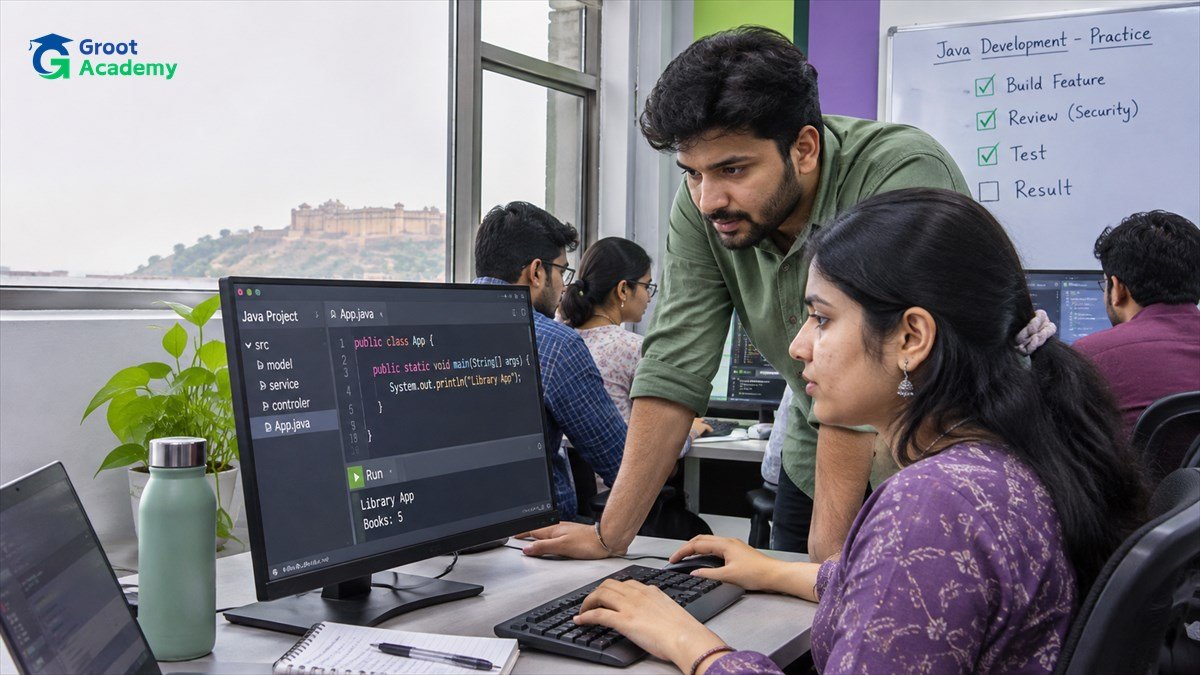
Java development becomes much easier when students understand the language fundamentals before moving into frameworks. A useful starting sequence includes variables, operators, conditions, loops, methods, arrays and object-oriented programming.
Important OOP concepts include classes, objects, inheritance, polymorphism, abstraction and encapsulation. Students should then practise exception handling, collections, file handling and multithreading so they understand how larger Java programs are organised.
Move from Java basics to backend development
Ready for the next step? The Advanced Java roadmap for 2026 connects collections, JDBC, web requests and testing in one practical project.
After Core Java, students can learn JDBC and SQL to connect applications with relational databases. This is an important bridge between programming and real application development.
Spring and Spring Boot can then introduce dependency management, web services, REST APIs and structured backend development. Rather than memorising framework annotations, students should understand the request flow, application layers and how data moves between an API and database.
Use the Spring Boot beginner roadmap for a foundation-first sequence from Java and HTTP concepts into persistence, testing and practical backend projects.
Students who need stronger database fundamentals can also read the SQL and Database career guide.
A foundation-first Java practice plan
Build one small program at each stage and keep the code in a version-controlled repository. The goal is to explain why a design works, not just to finish a tutorial.
- Language basics: write a console-based expense tracker with input checks, methods and simple tests. Practise conditions, loops, arrays and meaningful variable names.
- Objects and collections: model an expense, category and report. Use classes, interfaces and a collection to group or filter records. Handle missing and invalid data deliberately.
- Persistence: design a small SQL table, then connect the Java program with JDBC. Use prepared statements for user-supplied values and test what happens when a query returns no rows.
- Web layer: after the console and database versions are understandable, expose a small REST API with Spring Boot. Keep request handling, business rules and persistence responsibilities separate.
- Portfolio review: include setup instructions, sample requests, tests and a short explanation of trade-offs. Show one failure case alongside the successful flow.
For the framework-specific sequence, continue with the Spring Boot and microservices guide. Readers who want to know the Java faculty member can visit Satnam Singh's Groot Academy profile.
Java projects that build practical confidence
At Groot Academy Vijay Path, Mansarovar, Jaipur, the learning approach focuses on coding practice, assignments, problem-solving and project-based application development. Useful projects can include:
- Console-based student management application
- Java application with JDBC and MySQL
- CRUD application with layered code
- REST API using Spring Boot
- Backend module with validation and database operations
Projects encourage students to debug real errors, structure code and understand how individual Java concepts work together.
Where Java skills can lead
To connect Java backend skills with browser interfaces, follow the Java Full Stack roadmap for 2026 and build one application from UI to database.
If problem-solving is your next focus, follow the DSA with Java roadmap for 2026 for a staged sequence from arrays and collections to trees and graphs.
A Java learning path can support backend development, full stack Java development and enterprise application development. Students preparing for interviews should also strengthen problem-solving, SQL, Git and basic Data Structures and Algorithms.
For a broader comparison of development paths, see the Software Development and Coding career guide.
Frequently asked questions
Is Java suitable for beginners?
Yes, especially for students who want a structured introduction to object-oriented programming. Beginners should focus on Core Java before advanced frameworks.
Should I learn SQL with Java?
Yes. Database skills are important for most backend applications, and JDBC gives students practical experience connecting Java code to relational data.
When should I start Spring Boot?
Start after you are comfortable with Core Java, OOP, exceptions, collections and basic database programming. Strong fundamentals make framework learning much easier.
Use official references while practising
Dev.java's learning guides cover current Java language and library topics. Oracle's JDBC Basics tutorial explains connections, statements and result sets, though its examples target JDK 8. Check the Spring Boot first-application tutorial for a framework starting point and confirm the requirements for the version you install.
Build your Java development foundation
Explore Java learning at Groot Academy Vijay Path, Mansarovar, Jaipur with coding practice, database work, backend concepts and real projects.
View Course Details