

Java Full Stack Roadmap in 2020: From App to Deployment
A 2026 look back at 2020 Java, Spring Boot and React releases, with a practical browser-to-deployment study sequence.
What does a 2020 roadmap tell a learner today?
This guide was written in November 2026. It reconstructs a sensible 2020 Java full stack learning path from dated official release records. It is not a post published in 2020, a record of a Groot Academy syllabus from that year, or a claim that every Java team used the same tools. The distinct lesson of this checkpoint is to move beyond a browser and API demo: package, test and operate one small application so another person can run it.
A Java full stack app still had several layers: a browser interface, a Java service, persisted data and the configuration needed to release them. A learner could use different frontend frameworks or server-rendered pages. The most useful roadmap follows the request from click to database and back, then checks how that flow behaves after deployment.
Which release dates are verified?
OpenJDK's version record lists JDK 14 on 17 March 2020 and JDK 15 on 15 September 2020. Those dates do not mean a 2020 project had to use the newest JDK. A practical learning plan needed to check the Java version supported by its framework and dependencies. A January 2020 tutorial could not assume either release was already available.
Spring announced Spring Boot 2.3.0 on 15 May 2020. Its release note reports compatibility with Java 8 and 11 and support for Java 14. It also highlights buildpack image creation, layered jars, graceful shutdown and application availability probes. These are useful historical prompts for learning how a service is packaged and operated; they are not a recommendation to start a new application on that old version.
React's versioning policy dates React 17 to October 2020. React was one possible frontend choice, but it was not required for Java full stack work. If a tutorial mixes React 17 with a feature that appeared later, verify the feature against the version's documentation rather than trusting the year in its title.
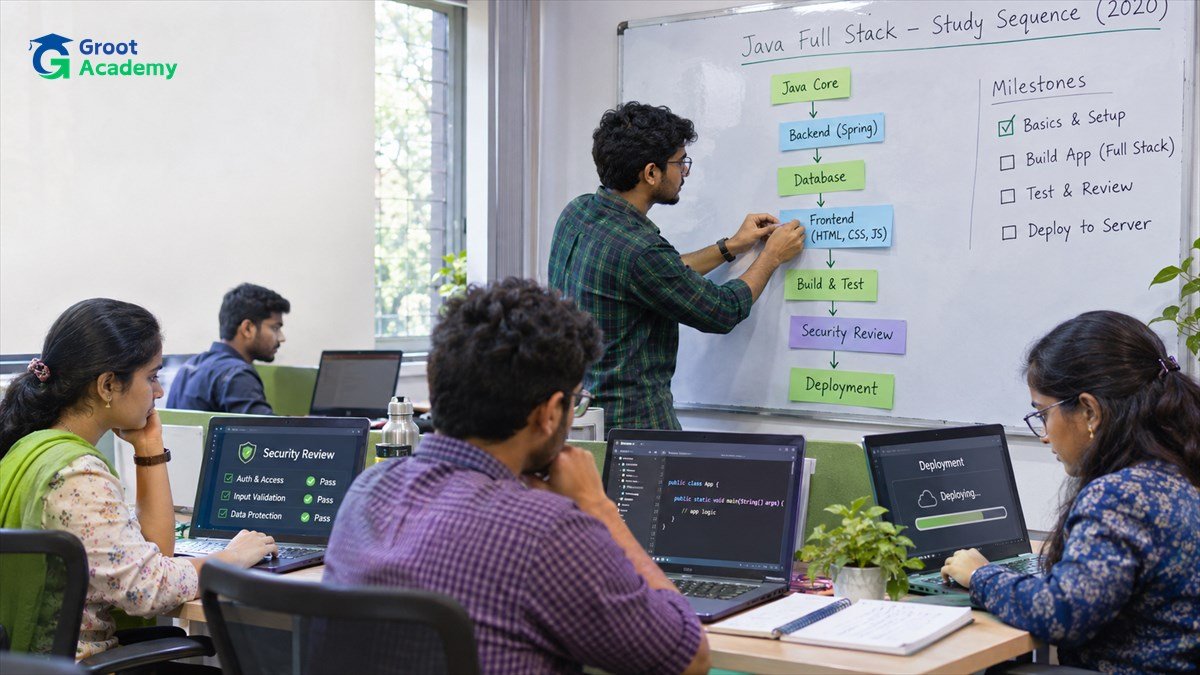
A practical learning sequence for a 2020-style project
- Browser foundations: build an accessible HTML form with responsive CSS and JavaScript validation. Inspect its network request and handle empty, loading, success and error states.
- Java foundations: practise classes, collections, exceptions and tests. Pin a Java version that matches the selected framework and document it in the project.
- Data model: design a few relational tables and constraints. Write basic SQL before relying on a persistence abstraction. Decide what a duplicate or missing record means to a user.
- Backend flow: receive an HTTP request, validate it, apply a business rule, persist data and return a deliberate response. Keep request handling, rules and data access understandable as separate responsibilities.
- Frontend integration: connect one form to one endpoint. A React interface was possible, but a smaller interface is sufficient if it proves the complete flow.
- Release the slice: run tests, create a deployable artifact, configure secrets outside source code and verify that the service starts and answers a basic request.
A useful exercise is a workshop booking app. Show available sessions, accept a booking, enforce capacity and display a result. Test the full and duplicate cases before adding more pages. Explain which layer owns capacity rules and how a database failure is reported. This is a suggested practice project, not evidence of a named mentor's 2020 teaching or employment.
What should deployment practice include?
The 2020 Spring Boot 2.3 release is especially useful as a historical anchor for packaging. Its buildpack support provided one way to create a container image, while layered jars helped organize image layers. A learner did not need a large microservices system to benefit from these ideas. Start with one service and a database, and document the commands, environment variables and health check needed to run them.
Distinguish an application that has started from one that is ready to serve traffic. Spring Boot 2.3's availability probes made this distinction visible in its release notes. Test a failed database connection, a graceful stop and a restarted service in a disposable environment. Keep credentials out of Git, review error responses for leaked details and confirm that a browser can reach only the intended API origin.
For a portfolio, include a short README with the chosen Java version, setup steps, sample requests and limitations. A screenshot alone cannot show whether the backend is reliable. A reviewer should be able to reproduce the booking flow and understand how it fails safely.
How to use this history for current learning
The 2021 retrospective follows this with JDK 17's September arrival and a fuller browser-to-database testing plan.
For the next compatibility checkpoint, the 2023 Spring Boot 3 retrospective examines Java 17, Jakarta APIs and realistic database tests.
For the preceding year, read the 2019 Java 11, Spring Boot 2.2 and React Hooks retrospective. Use the 2018 retrospective to see the earlier Java 11 and Spring Boot 2.0 context. The current Java full stack roadmap provides a present-day project path, while the Spring Boot guide goes deeper into API and release practice. Check current official documentation before selecting versions for any new application.
Groot Academy's Satnam Singh faculty profile provides current Java backend mentor context. This retrospective does not attribute a 2020 project, job or framework choice to him. If evaluating a course in Jaipur, ask which Java and Spring versions, tests, database exercises and deployment steps are in the current syllabus.
Frequently asked questions
Did every 2020 Java full stack project use React?
No. React was one frontend option. The backend, browser and data flow could be built with several interface approaches.
Should I install Spring Boot 2.3 for a new project?
Use its release record to understand 2020 history. For new work, select versions from current official compatibility and support documentation.
Why study deployment before adding many features?
A small deployable application reveals configuration, data and failure problems early. Once a complete slice works, you can add features with a clearer understanding of the system.
Primary release records
The dated claims above come from OpenJDK's version record, Spring's Boot 2.3.0 announcement and React's versioning policy. The recommended learning order is an editorial reconstruction, not a historical fact about one school or employer.
Study the current Java full stack path
Compare the current Java Full Stack Development course syllabus, projects and batch details in Jaipur.
Explore Java Full Stack Course