

Java Full Stack Roadmap in 2025: Java 25 and Spring Boot 4
Trace the 2025 Java full stack transition from Spring Boot 3.5 to Boot 4, alongside Java 25 and a practical application roadmap.
Why revisit the 2025 Java full stack roadmap?
This retrospective was written in November 2026; it is not a post published in 2025 or a record of a Groot Academy batch or Satnam Singh's work history. The year provides a useful framework-transition case study: Spring Boot 3.5 arrived in May, Oracle announced Java 25 in September, and Spring Boot 4 became generally available in November. Release timing matters because an early-year tutorial and a late-year migration guide did not describe the same available stack.
For a learner, the enduring objective remained a complete browser-to-database flow. Framework and JDK upgrades are useful context, but they do not replace HTTP, Java, data modelling, testing and deployment fundamentals. This roadmap is an editorial reconstruction based on release records, not a claim about which versions every team adopted.
What do the release records show?
Spring Boot 3.5.0 was released on 22 May 2025. The announcement highlighted structured logging improvements, SSL support for service connections and the ability to load properties from environment variables, among other changes. These illustrate practical topics to study in a backend project: configuration, observability and secure integration.
Oracle announced Java 24 on 18 March 2025. Java 25 followed on 16 September; Oracle described it as an LTS offering under its own support terms. Support and licensing arrangements are vendor-specific, so check the selected JDK distributor's terms rather than assuming every build has identical support.
Spring Boot 4.0 became available on 20 November 2025. Spring's release post describes its Spring Framework 7 foundation, modularized codebase, first-class Java 25 support and retained compatibility with Java 17. Therefore, Boot 4 was a late-year milestone; a Java learning plan from the beginning of 2025 should not present it as the only framework line available throughout the year.
React 19 had become stable in December 2024, so it was available as an optional client library during 2025. A Java full stack project could instead use server-rendered pages or another frontend. The backend's contract and the whole user flow matter more than selecting a particular UI library.
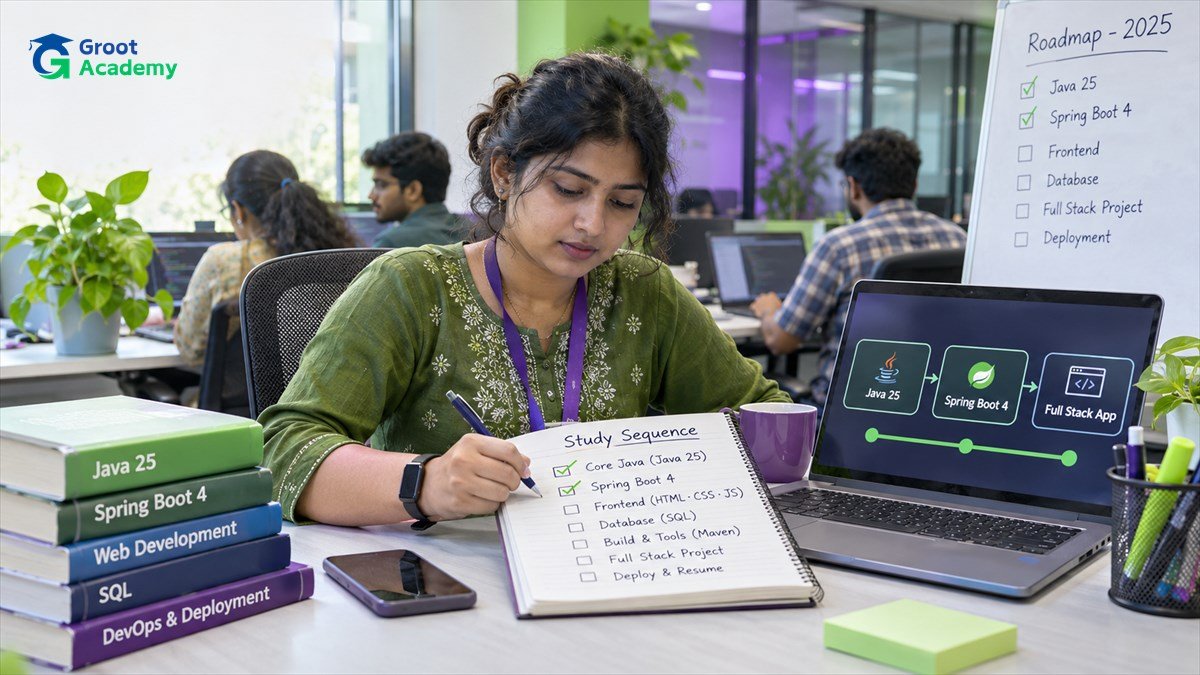
A practical learning sequence for a 2025-style project
- Browser and HTTP: create a responsive page with a form and list. Inspect requests, JSON, status codes, validation errors and keyboard behavior.
- Java foundations: practise types, classes, collections, exceptions and unit tests. Learn to explain a business rule before wrapping it in framework configuration.
- SQL and API design: model relational data, define keys and constraints, then specify endpoints and error responses before connecting the UI.
- Spring Boot service: build one vertical slice with validation, a domain rule, persistence and a deliberate HTTP response. Record exact Java, Spring and dependency versions.
- Integration tests: exercise the API with the database, check duplicate and missing records, and verify configuration such as environment-provided settings.
- Upgrade awareness: use a release-compatible framework and runtime. Read migration notes before crossing a major version boundary; do not change versions simply to make a portfolio project look newer.
- Deploy and explain: document setup, environment variables, secrets handling and deployment checks. Demonstrate one complete request after deployment.
How to approach the Spring Boot 3 to 4 boundary
Boot 4 was not just another patch release: Spring announced a new major generation built on Spring Framework 7 and highlighted modularization. For an existing service, begin by recording its current JDK, Boot version, dependencies and passing tests. Read the official migration guide and check each integration, build plugin and test starter for compatibility before changing the application.
For a learner starting a new project today, this 2025 transition is historical context. Select a currently supported release and follow its current compatibility guidance. The Java 27 and Spring Boot compatibility roadmap for 2027 covers current framework requirements and JDK migration checks. For an educational migration exercise, keep the application small, move one bounded area at a time and run tests after each change. A successful compile alone does not establish that authentication, serialization, persistence or operational behavior still works.
A project that demonstrates the transition
Build a training-session booking application with a browser screen, Java API and relational database. A user can view sessions, reserve a place and receive a useful result. The service validates input, prevents duplicate reservations, checks capacity and persists the booking. Test a successful reservation, a full session, invalid data, duplicate submission and a database failure.
Then make a separate upgrade branch that documents the starting versions and evaluates the project's migration to a newer Spring Boot generation. Update dependencies using the official migration guidance, preserve a passing test baseline and explain any changed configuration or imports. Keep the baseline and upgraded result distinct so that the exercise demonstrates evidence, not just a version-number change.
For a small portfolio project, report only what you actually measured and tested. Do not claim Boot 4 or Java 25 automatically makes an application faster, safer or employable. A reproducible setup, clear trade-offs and tests are stronger evidence than an unsupported outcome statement.
How to use this retrospective now
Read the 2024 retrospective for the preceding Java 21 and virtual-thread context, then follow the current Java full stack roadmap for a present-day sequence. The Spring Boot testing guide expands on testing API behavior, persistence and security. Historical release versions should not be copied as current recommendations.
Groot Academy's Satnam Singh faculty profile provides current Java backend mentor context. This article does not attribute a 2025 job, project, framework choice or authorship to him. Learners comparing Java full stack courses in Jaipur can ask which versions are currently taught, how upgrades are tested and what the final project must demonstrate.
Frequently asked questions
Was Spring Boot 4 available throughout 2025?
No. Spring's announcement dates Boot 4.0 general availability to 20 November 2025. Spring Boot 3.5 had been released in May, so the date matters when interpreting a 2025 tutorial.
Was Java 25 released before Java 24?
No. Oracle dates Java 24 to 18 March 2025 and Java 25 to 16 September 2025. Both release announcements are linked below.
Should a new project use Boot 3.5 or Boot 4 because this article discusses both?
This is a retrospective, not current installation advice. Check the current support status, compatibility requirements and migration guidance for the framework and JDK you plan to use.
Did a full stack project require React 19 in 2025?
No. React 19 was a stable option, but a Java service can connect to many types of browser UI. Choose the frontend that fits the project and make the HTTP contract clear.
Primary release sources
Historical release dates and compatibility statements use the official Spring Boot 3.5 release announcement, Oracle Java 24 and Java 25 announcements, the Spring Boot 4.0 release post and the React 19 announcement. The project and learning sequence are editorial recommendations.
Build a current Java full stack project
Review the current Java Full Stack Development course syllabus, project work and batch details in Jaipur.
Explore Java Full Stack Course