

Java Full Stack Roadmap in 2015: Spring Boot DevTools and React 0.14
A source-checked look at Java 8 foundations, the late-2015 Spring Boot 1.3 developer tools release and React 0.14 separating React DOM.
A 2026 retrospective on a 2015 Java full stack roadmap
This page was written on November 13, 2026. It is a retrospective based on dated release records, not an article published in 2015 or a claim about an academy's historical syllabus. Its focus is late-2015 developer workflow: framework tools that shortened the edit-run cycle and a React packaging change that clarified the boundary between UI components and browser rendering.
For the earlier Java 8 and Spring Boot 1.0 context, read the 2014 retrospective. The next year brought Spring Boot's more explicit test slices and React 15; see the 2016 retrospective.
What arrived during 2015?
Java 8 had become the relevant foundation for many new learning examples after its 2014 release. A beginner still needed core Java, object-oriented programming, collections, exceptions and SQL before being able to make sense of a web framework. The date of a tutorial matters: a 2015 guide may use a newer Java feature than an older environment supports.
Spring Boot 1.3.0 was announced on November 16, 2015, so it describes a late-year development option, not something available for all of 2015. Its new spring-boot-devtools module aimed to improve development-time feedback, including automatic application restarts and LiveReload support. Earlier in the year, the Boot 1.2 line was still receiving maintenance releases. A careful retrospective should not flatten this release timeline into a single stack that existed from January onward.
React 0.14 was released on October 7, 2015. A key architectural packaging change split the browser-specific React DOM APIs into the separate react-dom package, while the react package retained component and element APIs. The announcement also encouraged using npm and a bundler such as Browserify or webpack. This is a useful historical example of frontend tooling becoming a more explicit part of a full stack workflow; React remained optional for Java applications.
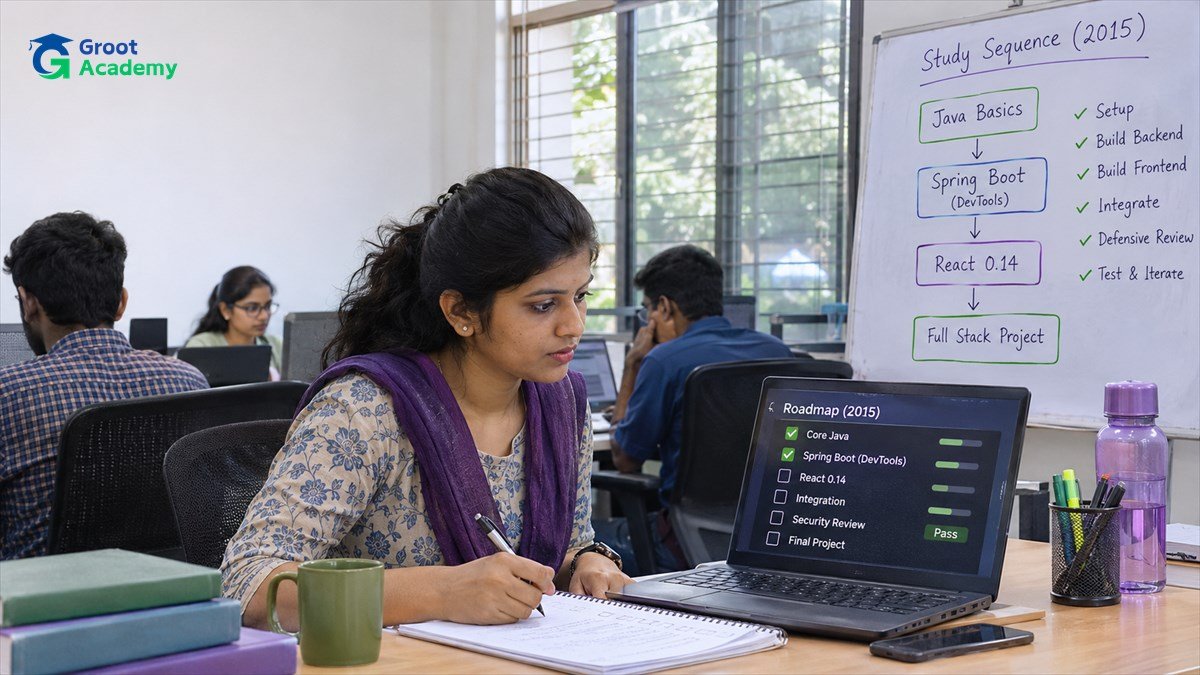
A practical learning path for late 2015
- Build browser basics: practise HTML, CSS and JavaScript forms. Learn how a browser sends an HTTP request and displays a response before adding a client framework.
- Learn Java clearly: write small programs with classes, interfaces, collections and exceptions. Add unit tests and SQL exercises so the application rules are understandable outside Spring.
- Connect a data model: design a few relational tables, write queries and make explicit what should happen when data is missing or an operation fails.
- Build a web service: learn request mapping, validation, service logic and persistence in a Java framework. For a period-specific late-2015 example, Boot 1.3 is relevant after its November release; do not treat it as the only possible framework.
- Shorten the development loop: understand how a development tool can restart an application after code changes, while keeping development-only behavior distinct from production configuration.
- Choose a frontend approach: render pages on the server or build a JavaScript interface. If reproducing React 0.14 examples, account for the separate
reactandreact-dompackages and the build tools described by the original guide. - Test the integrated journey: exercise a complete user action from browser to Java service and database, and document steps another learner can repeat.
Use a small application to practise integration
A course-enrolment form is enough to practise the full path: show a course, validate a learner's request, save it and return a confirmation. Begin with server-rendered output if that makes the flow easier to understand. Then, if useful, replace one interface interaction with a JavaScript component while keeping the backend contract stable.
For a development workflow exercise, change a service response and observe how the local application restarts. For a frontend exercise, render a small component and make the package boundary explicit. Keep these as learning experiments; framework release notes do not prove that every team or course used these tools.
How to read a 2015 tutorial today
Spring Boot 1.3 and React 0.14 are historical examples, not current recommendations for a new application. Check supported versions, security guidance, dependency compatibility and current installation instructions before starting a project. A tutorial's most durable material may be its explanation of HTTP, data flow and testing rather than its old commands.
This article does not assert that Satnam Singh used these tools in 2015. For current faculty information, visit the Groot Academy Java backend faculty profile. For the current project sequence, use the 2026 Java Full Stack roadmap.
Frequently asked questions
Was Spring Boot 1.3 available for all of 2015?
No. The 1.3.0 release announcement was published on November 16, 2015. It is best described as a late-2015 release.
What changed in React 0.14?
The release separated browser rendering APIs into a dedicated react-dom package while keeping reusable component APIs in react. Read the original upgrade notes when maintaining code from that period.
Does a Java full stack app need React?
No. React was one option. A Java application may use server-rendered pages or a different frontend architecture.
Primary historical sources
- Spring Boot 1.3.0 release announcement for its November date and DevTools highlights.
- Spring Boot 1.2.5 announcement as an example of maintenance activity earlier in the year.
- React 0.14 release announcement for the package split and setup guidance.
- Oracle Java SE 8 documentation archive for the period's Java platform references.
The sources establish release details. The learning path is an educational interpretation, not a universal historical curriculum.
Continue with a current Java full stack path
Use this historical guide to understand older examples, then explore a current Java full stack project sequence in Jaipur.
Explore Current Java Full Stack Course