

Java Full Stack Roadmap in 2023: The Spring Boot 3 Transition
A 2026 retrospective on the 2023 Java 17 and Spring Boot 3 learning path, including Jakarta migration and realistic database tests.
What made a 2023 Java full stack roadmap different?
This article was written in November 2026 as a retrospective. It is not a post published in 2023 or a record of a Groot Academy course from that year. Its purpose is to help readers interpret period-specific Java tutorials. A 2023 learner could build the same browser-to-database flow described in earlier roadmaps, but the transition to Spring Boot 3 changed the Java baseline and Jakarta API namespace. That compatibility work is the distinctive lesson of this year.
There was no universal frontend choice. A server-rendered interface or JavaScript application could both connect to a Java backend. Learn the request, validation, persistence and response flow before selecting extra libraries. A working screen without tests or a clear data model is an incomplete full stack project.
What do official release records establish?
Spring Boot 3.0 became generally available in November 2022, before the start of 2023. Its announcement states a Java 17 baseline and Jakarta EE support. Spring's migration guidance explains that the Jakarta EE 9 APIs use the jakarta.* namespace rather than the older javax.* namespace. This matters when reading code examples and updating dependencies; a package rename alone does not prove an entire application has been migrated.
Spring Boot 3.1 was announced on 18 May 2023. Its release note highlights development-time external services through Testcontainers and Docker Compose, plus simpler Testcontainers configuration for integration tests. These are useful examples of testing a service with a realistic database instead of relying only on an in-memory substitute.
OpenJDK's version record dates JDK 21 to September 2023. It was therefore not available for a January 2023 tutorial. Java 17 was already the minimum for Spring Boot 3; a project should choose a runtime based on the specific framework version's compatibility documentation, not on the newest JDK number alone. React 18 had been released in March 2022, so it was an available frontend option during 2023, never a requirement for Java full stack work.
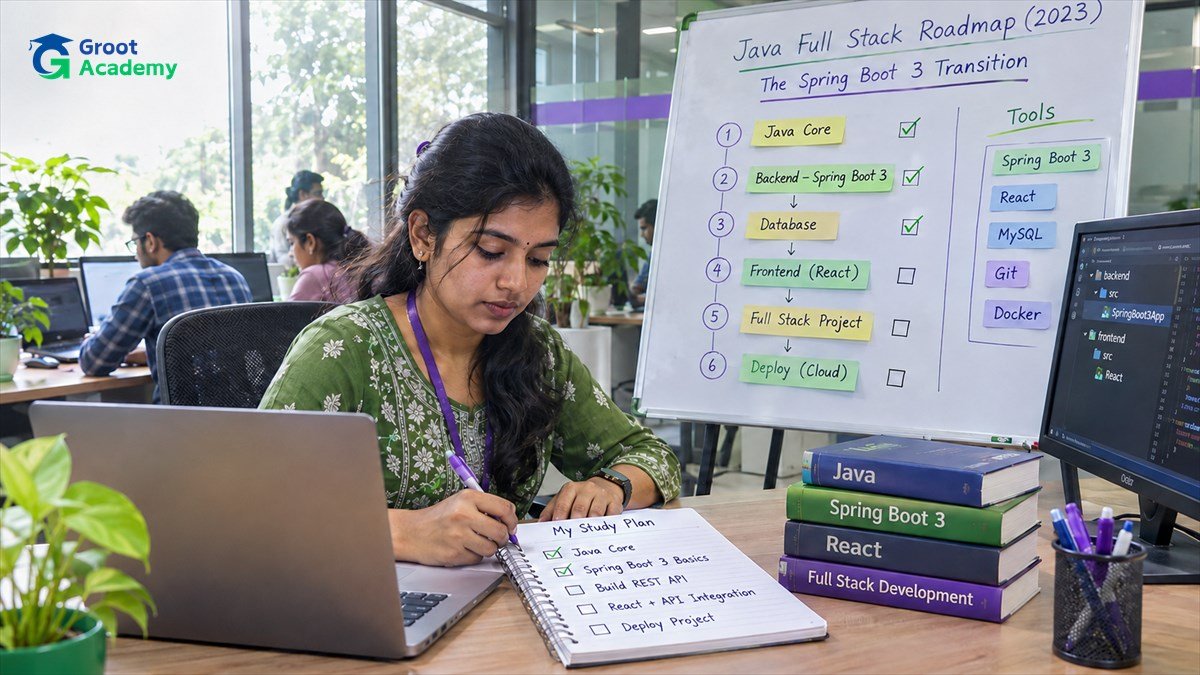
A practical 2023 learning sequence
- Browser and HTTP: build a responsive form using HTML, CSS and JavaScript. Inspect methods, status codes, request bodies and validation messages in the browser network panel.
- Java and SQL: practise Java objects, collections, exceptions, tests and relational queries. Explain a data constraint before asking a framework to enforce it.
- Spring Boot 3 service: start with a compatible Java runtime, one resource and one endpoint. Keep request mapping, domain rule and data access responsibilities clear.
- Persistence: model two or three related tables, handle missing and duplicate records, and make the API responses deliberate rather than exposing raw exceptions.
- Frontend integration: connect one user action to the endpoint. Use React only if the project needs it; plain JavaScript or a server-rendered page can demonstrate the same full flow.
- Tests and release: exercise the API with a database that resembles the real environment, document setup and secrets, then verify a deployed request end to end.
A careful Spring Boot 2 to 3 migration checklist
For an existing application, first record its Java version, Spring Boot version, dependencies and passing tests. Read the migration notes for every library that interacts with the web or persistence APIs. Update to a Java 17-capable build and check where a javax.* import needs a supported jakarta.* counterpart. Review security configuration and integration behavior rather than doing a blind text replacement. Run the tests after each bounded change, then inspect the first failing request and its dependency graph.
A new learner does not need to migrate a real legacy product to understand the issue. Create a tiny service from current documentation, then compare one older code sample with its compatible equivalent. Write down what changed and why. This makes the 2023 transition concrete without pretending that every old tutorial is unusable.
A project that proves the complete flow
Build a small course-seat booking app. Visitors can list classes and request a seat; the server checks capacity and duplicate bookings, then saves the result. Test an available seat, a full class, an invalid request and a lost database connection. A database-backed integration test checks more than a controller-only test, while a browser check confirms that the user sees a helpful error. Keep the project small enough that each failure can be explained.
Document the chosen Java and Spring versions, the database setup, environment variables and a sample API request. Keep credentials out of Git. A portfolio reviewer should be able to reproduce the flow and understand the compatibility choices. This is a suggested exercise, not a claim that a named mentor built or taught this project in 2023.
How should a learner use this today?
For the transition year immediately before this roadmap, read the 2022 Java full stack retrospective. Read the 2020 retrospective for the earlier packaging and operations context. For the next year’s Java 21 and virtual-thread context, read the 2024 retrospective. Use the current Java full stack roadmap and Spring Boot beginner guide for a present-day study sequence. Check current support and compatibility documentation before starting a new project; a 2023 stack is historical context, not a default install list.
Groot Academy's Satnam Singh faculty profile provides current Java backend mentor context. This retrospective does not claim his 2023 employment, technical choices or authorship. If comparing a course in Jaipur, ask which Java and Spring versions, database tests and final project are in its current syllabus.
Frequently asked questions
Did Spring Boot 3 first appear in 2023?
No. Spring announced Spring Boot 3.0 GA in November 2022; version 3.1 followed in May 2023.
Was Java 21 required for Spring Boot 3 in 2023?
No. Spring Boot 3.0 set a Java 17 baseline. JDK 21 arrived later in September 2023. Check the exact Boot release's compatibility information before choosing a runtime.
Can I migrate by changing every javax import to jakarta?
No. Review dependencies, runtime configuration, security and behavior as well. A mechanical rename is only one possible part of a version migration.
Primary release and migration records
Historical dates and compatibility statements above are supported by Spring Boot 3.0 GA, Spring's migration guidance, Spring Boot 3.1 GA, the OpenJDK version record and the React 18 announcement. The learning order is an editorial recommendation.
Build a current Java full stack project
Review the current Java Full Stack Development course syllabus, project work and batch details in Jaipur.
Explore Java Full Stack Course