


Java Microservices Course in Jaipur
Understand how larger Java applications can be decomposed into independently deployable services, with Spring Boot used to build and connect API-driven components.
- Practical learning
- Project practice
- Jaipur
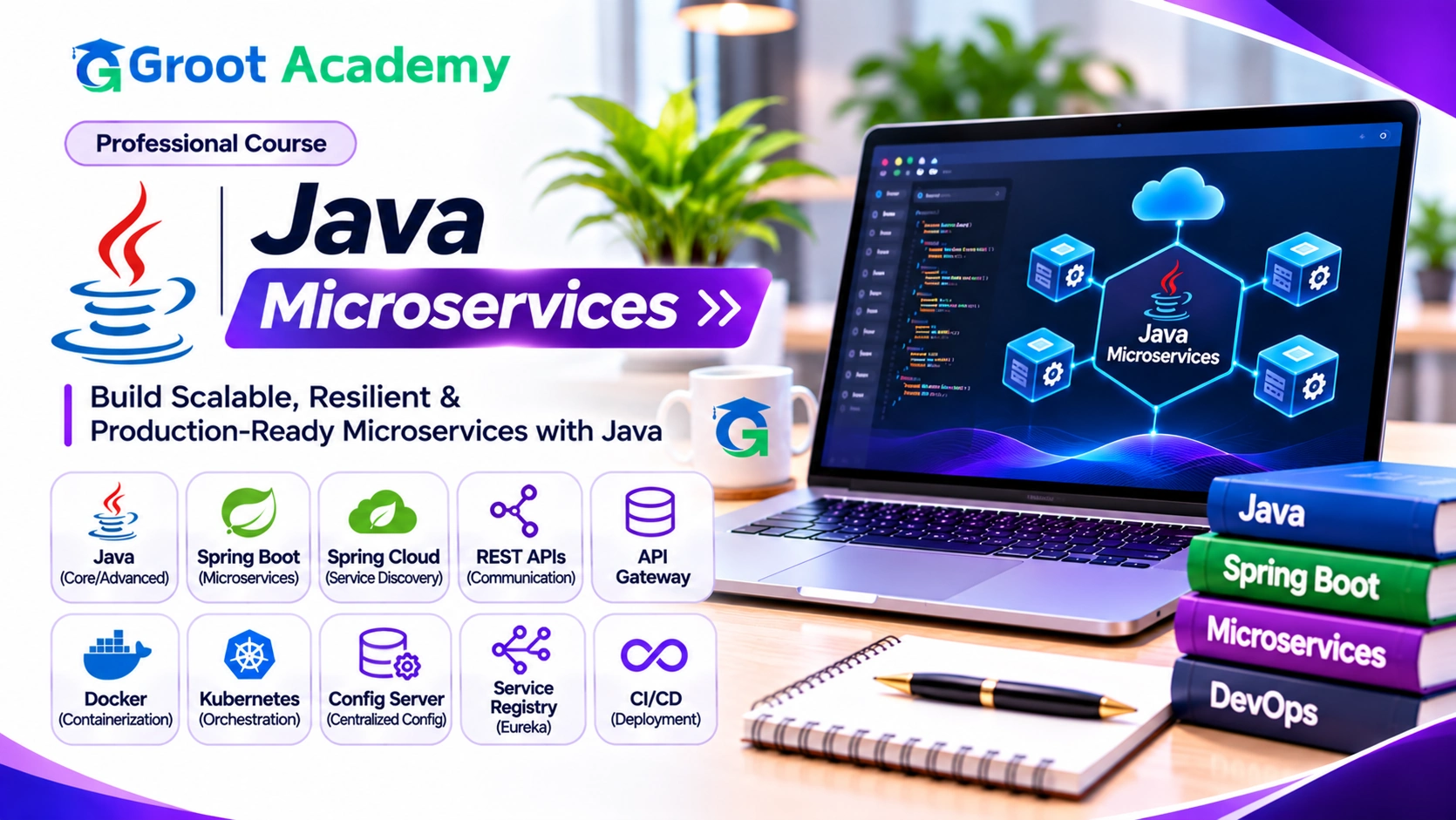
Java Microservices
Build your foundation in Java Microservices
Understand how larger Java applications can be decomposed into independently deployable services, with Spring Boot used to build and connect API-driven components.
The legacy microservices page introduced service-oriented architecture, modularity and the differences between monolithic and microservices approaches.
This migrated path keeps the architecture focus and places microservices after Core Java, Spring and Spring Boot fundamentals.
Who can join?
Java backend developers Spring Boot learners Developers moving from monoliths to services Students preparing cloud/backend architecture skills
Skills and tools
Course curriculum
Explore the published learning outline below. Confirm the detailed syllabus and module coverage for your chosen batch with the course team.
Architecture
Monoliths and services · Bounded responsibility · API contracts
Building Services
Spring Boot service setup · REST endpoints · Validation and error handling
Service Integration
Synchronous communication concepts · Configuration · Data ownership basics
Reliability Foundations
Logging and observability · Resilience concepts · Testing and deployment considerations
Project practice ideas
Use these examples to discuss suitable practice work with your trainer.
Single-service REST application
Use this as a practical project brief to plan, build, test and document your work.
Two-service integration exercise
Use this as a practical project brief to plan, build, test and document your work.
Configuration/environment project
Use this as a practical project brief to plan, build, test and document your work.
Logging/health-check exercise
Use this as a practical project brief to plan, build, test and document your work.
Microservices architecture capstone
Use this as a practical project brief to plan, build, test and document your work.
Frequently asked questions
Quick answers about learning, projects, batches and the next step at Groot Academy.
Do I need Spring Boot first?
Yes. A solid Spring Boot and REST API foundation makes microservices much easier to learn.
Is this only about coding?
No. Service boundaries, communication and operational trade-offs are architecture topics as well.
Are databases covered?
The roadmap introduces data ownership and persistence considerations for services.
Is security included?
Security foundations can be introduced, while deeper authentication/authorization should follow core service development.
Who is this course for?
Java backend developers Spring Boot learners Developers moving from monoliths to services Students preparing cloud/backend architecture skills
How can I confirm fees, duration and batch timings?
Contact Groot Academy for the current syllabus, fees, duration and available learning modes before enrolling. These details depend on the selected course and batch.
What will I study in the Java Microservices course?
Understand how larger Java applications can be decomposed into independently deployable services, with Spring Boot used to build and connect API-driven components.
Which skills and tools are covered in Java Microservices?
The published learning outline includes Monolith vs microservices trade-offs, Service boundaries and API contracts, Spring Boot service structure, REST communication concepts, Configuration and environment management, Persistence per service concepts. See the skills section for the complete current outline and confirm the batch syllabus before joining.
What topics are included in the Java Microservices curriculum?
The listed modules include Architecture, Building Services, Service Integration, Reliability Foundations. Read the curriculum section for details; the delivery sequence can vary by batch.
What practical projects can I explore during Java Microservices?
The page lists practice ideas such as Single-service REST application, Two-service integration exercise, Configuration/environment project, Logging/health-check exercise. Ask the course team which project activities are included in your particular batch.
How can I use Java Microservices projects in my portfolio?
Document the problem, the tools you used, the decisions you made and the result. Include working examples or a repository where appropriate, and explain your own contribution clearly.
Can a beginner start learning Java Microservices?
Compare the course prerequisites and learning outline with your current skills. Beginners can ask the team which foundations to practise first and whether the next batch is suitable for their level.
What should I prepare before a Java Microservices batch?
Review any stated prerequisites, plan regular practice time and ask which device, software and setup are required for the current batch.
Are online or classroom batches available for Java Microservices?
Delivery mode depends on the active course batch. Contact Groot Academy to check the current online, offline or hybrid options instead of assuming every mode is available.
How can I check the latest Java Microservices syllabus?
Review the published curriculum on this page and request the latest batch-specific outline from the course team. Topics or sequencing can change as the program is updated.
How much practice time should I plan for Java Microservices?
Set aside consistent time to review lessons, practise exercises and work on projects. The appropriate weekly commitment depends on your experience, selected batch and course scope.
Will I receive a certificate after Java Microservices?
Ask the course team about certificate availability, issuer, completion criteria and verification process for the specific batch. Do not assume a certificate is automatic for every program.
Does taking Java Microservices guarantee a job?
No course alone guarantees employment. A strong learning plan combines technical understanding, independent projects, communication, interviews and suitable opportunities.
Can I ask about assignments and assessments before joining Java Microservices?
Yes. Request the current batch learning plan and ask how exercises, project reviews, feedback and progress checks are organised.
What happens if I miss a Java Microservices class?
Make-up lessons, recordings and attendance rules depend on the batch policy. Confirm these arrangements directly before paying or enrolling.
How do I enquire or enrol in Java Microservices?
Use the enquiry form on the course page or contact Groot Academy. First confirm eligibility, current syllabus, schedule, fees and any applicable terms.
Ready to discuss Java Microservices?
Ask the course team about syllabus coverage, current batch timings, fees, duration and learning modes before you decide.