

Java Full Stack Roadmap in 2018: A Retrospective for Learners
A 2026 look back at a plausible 2018 Java full stack learning sequence, grounded in dated Java, Spring Boot and React release records.
Why look back at a 2018 Java full stack roadmap?
For the earlier Java 8 and Spring Boot 1.0 release context, read the source-checked 2014 retrospective before comparing this later stack.
For the immediate year before this timeline, read the 2017 retrospective on Java 9 modules, Spring Boot release stages and React 16.
This article was written in November 2026. It is a retrospective, not a blog post published in 2018 or a claim about one academy's 2018 syllabus. Looking back helps learners reading old tutorials understand which parts describe durable web development concepts and which parts depend on a version or a particular project. A roadmap from that year would still connect a browser interface to a Java service and database, but the exact libraries and setup instructions could differ from a current course.
There was no single universal "Java full stack" stack in 2018. A team could use server-rendered pages, a JavaScript frontend or a mix. The sequence below is a plausible learning path based on tools available then, not a claim that every developer followed it.
What did the dated release records show?
Java 8 was already established by 2018, and JDK 11 arrived in September that year according to OpenJDK's version record. A tutorial written early in 2018 therefore could not have been assuming JDK 11 was already available. Always identify the date of a tutorial before copying its version instructions.
Spring announced Spring Boot 2.0 general availability on 1 March 2018. Its announcement described a Java 8 baseline and support for Spring Framework 5.0. That makes it a relevant historical reference for a 2018 Java backend path, but not a recommendation to start a new project on that old release today.
React's official versions page lists React 16 releases throughout 2018. It also places React 16.8, the release associated with Hooks, in February 2019. A supposedly "2018" tutorial that teaches Hooks as a then-current feature needs its chronology checked. React was one possible frontend choice, not a required part of Java full stack development.
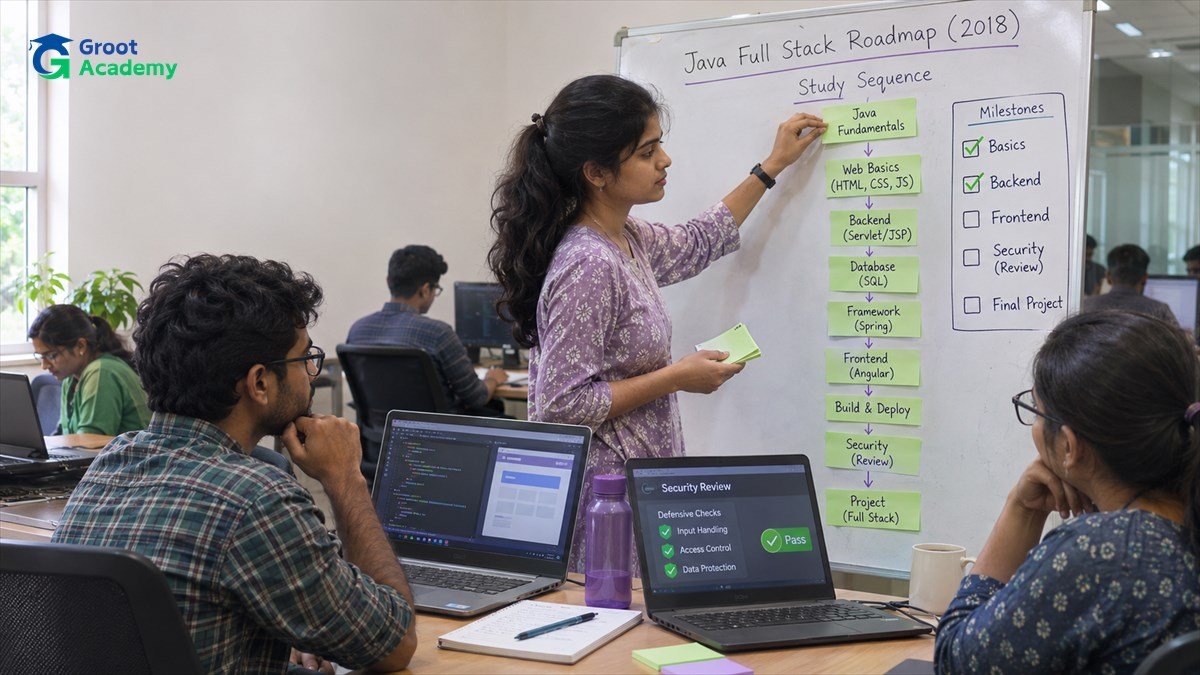
A reasonable 2018 learning sequence
- Browser basics: build pages with HTML, CSS and JavaScript. Learn forms, responsive layout and how the browser sends an HTTP request.
- Java foundations: practise classes, interfaces, collections, exceptions and testing. Explain the input and output of each method before introducing a framework.
- Relational data: write SQL queries, model relationships and connect Java code to a database. Learn how errors and transactions affect the result a user sees.
- Web backend: create a small Java service. Spring Boot 2.0 was one available starting point in 2018 after its release. Understand request mapping, business rules and persistence rather than treating annotations as the whole application.
- Frontend integration: render a page on the server or use a separate JavaScript interface. If choosing React 16, learn components and state as documented for that version. Connect one user action to one backend endpoint.
- Release and maintenance: test the complete browser-to-database flow, document how to run it, and keep configuration out of source code.
A small course booking app would have been a useful practice project: display courses, request a seat, store the booking and report when capacity is full. This is an educational example rather than evidence of a particular 2018 course. The most durable skill is explaining where each rule belongs and how a failed request moves through the system.
What should an old tutorial not decide for you today?
Old installation commands, dependency versions and security examples should be treated as historical. The browser's role, HTTP request flow, data modelling and testing habits remain useful, but the library versions and compatibility rules must be checked again. React's Hooks chronology is one concrete example of why a tutorial's date matters.
Do not assume that migrating a 2018 project is as simple as increasing one version number. Read release notes for each major jump, update code and dependencies in small steps, and run the project's tests after each change. A version-specific guide is useful for understanding an old codebase; current official documentation is the starting point for a new one.
Likewise, do not infer a person's work history from a technology timeline. This article does not claim Satnam Singh used any particular framework in 2018. For current mentor information, see his Groot Academy Java backend faculty profile.
How to apply the history to a current study plan
To follow what changed next in packaging and operating a Java application, continue to the 2020 Java full stack retrospective.
If your goal is to build now, use the 2026 Java Full Stack roadmap for a version-aware project sequence. Use the Java foundations guide if classes, collections and exceptions are still new, then the Spring Boot beginner roadmap for API and persistence practice.
When comparing a course, ask for its current frontend choice, Java and Spring versions, database work, testing approach and final project. Those answers are more useful than a claim that a stack is "the best" because it was popular in one year. The historical view should help you read older material critically and choose current documentation intentionally.
Frequently asked questions
Was React required for Java full stack in 2018?
No. React 16 was available, but Java applications could use different frontend approaches. The right choice depended on the project and team.
Can I use a Spring Boot 2.0 tutorial to start a new project?
It can explain historical concepts, but check current Spring documentation for supported dependencies and Java requirements before starting a new project.
Why mention JDK 11 if it arrived late in 2018?
Its September release shows that even within one year the available tooling changed. A roadmap should not present a late-year release as if it had been available all year.
Primary historical sources
Release dates and versions above come from the OpenJDK version record, Spring Boot 2.0 announcement and React versions archive. For new work, check the current documentation rather than assuming an archived example still matches your toolchain.
Learn the current Java full stack workflow
Use the 2018 timeline for context, then review the current Java Full Stack Development course syllabus and projects in Jaipur.
Explore Current Java Full Stack Course