

Java Full Stack Roadmap in 2014: A Source-Checked Retrospective
A 2026 retrospective on what a Java full stack learner could study in 2014 and why old version-specific advice needs care.
Why revisit a 2014 Java full stack roadmap?
This article was written in November 2026. It is a retrospective, not a post published in 2014 or evidence of a particular academy's 2014 course. It answers a common problem: an old tutorial may describe useful concepts while giving installation, version or security advice that no longer fits a new project. In 2014, as now, a full stack learner needed to understand the browser, server, data and the request flowing between them. The tools available within that year changed, so the date of the tutorial matters.
There was no single required Java full stack combination. Server-rendered Java pages and separate JavaScript interfaces were both possible approaches. React was an option, not a prerequisite. The sequence below is an educational reconstruction based on dated release records.
What was actually available in 2014?
Oracle's Java SE specification archive records Java SE 8 as released in March 2014. Java 8 brought language and library features such as lambda expressions and streams, but an early-2014 lesson could reasonably have used Java 7. Do not describe Java 8 as available throughout the whole year.
Spring's release announcement dates Spring Boot 1.0 general availability to 1 April 2014. That makes it a valid example for a later-2014 backend path, not for a January lesson presented as generally available. A learner could also build a Java web app without Spring Boot. The release date tells us what was possible, not what every team adopted.
React's official version archive lists v0.11.0 in July and v0.12.0 in October 2014. These were early pre-1.0 releases. A 2014 roadmap should not silently assume modern React features or present today's component examples as period-accurate. HTML, CSS and JavaScript fundamentals remained necessary whichever interface approach a project chose.
A plausible learning sequence for that period
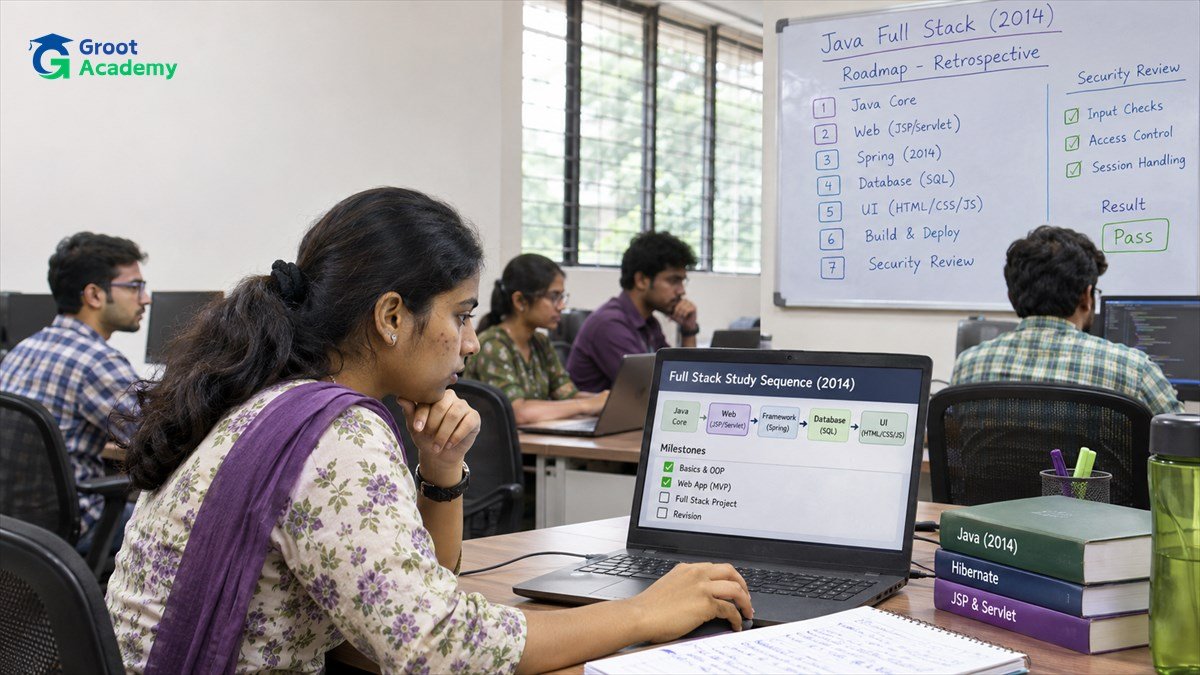
- Start in the browser: create a responsive HTML page, style it with CSS, handle a form with JavaScript and inspect the network request. Understand GET, POST, status codes and basic accessibility before adopting a library.
- Learn core Java: practise objects, interfaces, collections, exceptions and unit tests. If studying a tutorial from after March 2014, identify where Java 8 features are used instead of assuming the code works on an older JDK.
- Model relational data: design tables for a small booking or inventory example, write basic SQL and decide which operations must succeed together. Learn what happens when validation or a database write fails.
- Build a web backend: receive a request, apply a rule, save or fetch data and return a useful response. Spring Boot 1.0 was one later-2014 route to a runnable service. The goal is to understand the request and data flow, not memorize period-specific setup commands.
- Connect the interface: start with a simple server-rendered page or JavaScript-enhanced form. If exploring early React, check the archived version and examples carefully. Show loading and error states as well as success.
- Test an end-to-end task: submit a booking, confirm that it persists, reject a duplicate and explain what the user sees when a request fails. Record the version and setup details needed to reproduce the project.
A workshop booking project makes the layers concrete. List sessions, accept a booking, enforce capacity and show confirmation. This is a suggested practice exercise, not a claim that any named mentor taught it in 2014. A smaller finished application is more useful than a long technology list with no working flow.
How should a learner use 2014 material today?
Use old lessons to understand why a design was chosen and how the layers fit together. For a new application, check current Java and Spring documentation, supported versions, dependency requirements and security guidance. Old code can contain APIs or configuration that need migration. Do not copy a dated snippet into production merely because the example still compiles.
For another historical checkpoint, read the 2018 retrospective. For a current project sequence, use the 2026 Java full stack roadmap and the Java foundations guide. Groot Academy's Satnam Singh faculty profile gives current mentor context; this historical article makes no claim about his 2014 employment, syllabus or tool use.
Frequently asked questions
Was Spring Boot already available at the start of 2014?
Its 1.0 general availability announcement is dated 1 April 2014. Earlier release candidates existed, but a January learning plan should not describe 1.0 GA as already released.
Did a Java full stack developer have to learn React in 2014?
No. React had early releases that year, but a Java web interface could be built in other ways. The browser, HTTP and data foundations applied across approaches.
Should I install the exact versions named in an old roadmap?
Only when maintaining or reproducing an old project in a suitable test environment. For a new project, start with current supported documentation and verify compatibility before selecting versions.
Primary release records
The historical dates in this article come from Oracle's Java SE specification archive, Spring's Spring Boot 1.0 GA announcement and React's version archive. The proposed study order is an editorial learning recommendation, not a historical release claim.
Build with the current Java full stack workflow
Use this historical guide for context, then review the current Java Full Stack Development course syllabus and project work in Jaipur.
View Current Java Full Stack Course