

Java Full Stack Roadmap in 2017: Java 9 Modules, Spring and React 16
A source-checked look back at a practical 2017 Java full stack learning sequence and the release chronology learners need to understand.
A retrospective, not a post published in 2017
This guide was written on November 13, 2026. It looks back at tools and release milestones from 2017; it is not a recovered 2017 article, a claim about a specific academy syllabus, or a biography of an instructor. The sequence below is a practical learning interpretation of the dated release record, not a claim that every team used the same stack.
For the earlier Java 8 and Spring Boot 1.0 context, see our 2014 Java full stack retrospective, then the 2016 retrospective on Spring Boot test slices and React 15. The next year's changes are covered in the 2018 retrospective.
What was available during 2017?
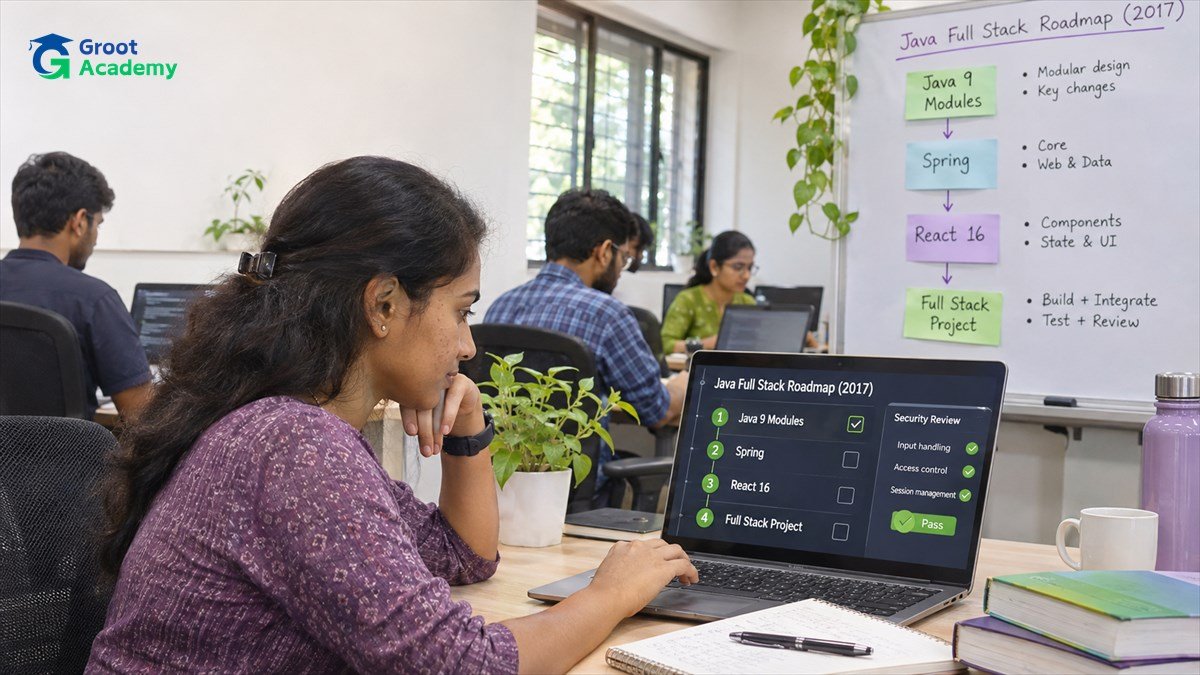
Java 8 remained a practical foundation for learning application development. Java 9 arrived in September 2017 with the Java Platform Module System, a way to organize applications and the JDK into modules with explicit dependencies. Modules mattered especially when maintaining or designing modular Java code; they were not a prerequisite for every beginner web project. A learner should understand classes, interfaces, collections and tests before spending time on module descriptors.
Spring Boot 1.5 was an established release line in 2017. Spring announced Boot 1.5.1 in January and 1.5.4 in June. In May, Spring made Boot 2.0.0 M1 available as a milestone, including work built on Spring Framework 5 and reactive WebFlux. That milestone was not a general availability release: Spring announced Boot 2.0 GA on March 1, 2018. Reading the release stage carefully avoids treating a preview as the normal production choice for all of 2017.
React 16 was released on September 26, 2017. Its announcement introduced the Fiber-based rewrite and features such as error boundaries and fragments. This was one frontend option among several; a Java backend did not require React, and server-rendered pages or another JavaScript approach could also fit a project.
A practical Java full stack learning sequence for 2017
- Learn browser fundamentals: practise semantic HTML, CSS layout and JavaScript. Understand forms, browser events, HTTP requests and how to inspect a response.
- Build Java foundations: use Java 8 for classes, interfaces, collections, exceptions and small unit tests. Solve problems with plain Java before adding framework annotations.
- Model and query data: learn relational tables, keys, joins and transactions with SQL. Connect the data model to a real use case rather than memorizing queries in isolation.
- Create a Java web service: follow a stable Spring Boot 1.5 tutorial for period-appropriate examples, or inspect Boot 2.0 milestones as previews. Learn routing, validation, business rules and persistence, and check the release stage and compatibility notes of any guide.
- Connect a user interface: choose server-rendered pages or a JavaScript frontend. If practising React 16, learn components, props, state and error handling from documentation for that release; do not assume later features existed in 2017.
- Test and package the whole flow: verify a browser action reaches the service, changes data correctly and returns understandable success or error states. Keep configuration separate and write down reproducible setup steps.
For a new learner, the order matters more than collecting framework names. A clear request path, reliable data model and tests teach transferable skills; a specific release number only describes the historical environment.
Use one small project to connect the layers
A course-enrolment or library-booking application makes a useful exercise. Show a list of items, validate a request, save it to a relational database and return a confirmation. Add a test for duplicate or unavailable bookings, then make the result visible in the browser. This is a suggested learning exercise, not a claim about a particular 2017 course or production application.
Keep the first version small: one or two pages, a few endpoints and a modest schema. Once the flow works, improve one concern at a time, such as form validation, error messages, automated tests or deployment configuration.
What remains useful to learners today?
The historical framework versions are not a recommendation for new projects. Use current Java and Spring documentation for supported versions, security fixes and setup. Use archived documentation only when understanding an older codebase. The durable lessons are still relevant: learn the language, model data carefully, understand HTTP, test the complete user journey and verify what a tutorial's version actually supports.
This timeline also does not establish Satnam Singh's personal work history or the tools he used in 2017. For current faculty information, see the Groot Academy Java backend faculty profile. For a present-day sequence, continue to the 2026 Java Full Stack roadmap.
Frequently asked questions
Was Java 9 used for every Java web project in 2017?
No. Java 9 was released in September, and adoption depended on each project's requirements and dependencies. Java 8 remained relevant; modules were most useful when a project benefited from explicit modular boundaries.
Was Spring Boot 2 generally available in 2017?
No. Boot 2.0.0 M1 was a milestone announced in May 2017. Spring announced general availability on March 1, 2018.
Did a Java full stack developer have to use React 16?
No. React 16 was available from September 2017, but frontend choices varied. Server-rendered interfaces and other JavaScript frameworks were also possible.
Primary historical sources
- Oracle Java SE 9 What's New for the Java Platform Module System.
- Spring Boot 1.5.1 release announcement and Spring Boot 1.5.4 announcement.
- Spring Boot 2.0.0 M1 announcement and Spring Boot 2.0 GA announcement.
- React 16.0 release announcement.
Release records describe what shipped and when; they do not prescribe a universal curriculum. For new work, always consult current official documentation.
Build with a current Java full stack roadmap
Use this historical timeline for context, then explore a current Java Full Stack Development project path in Jaipur.
Explore Current Java Full Stack Course