


Full Stack Developer Course in Jaipur
Learn how complete web applications are planned, built, connected and deployed. This Jaipur full stack development course combines frontend engineering, backend development, databases, APIs, authentication, Git workflows and practical project work in one structured learning path.
- Practical learning
- Project practice
- Jaipur
Full Stack Developer
Build your foundation in Full Stack Developer
Learn how complete web applications are planned, built, connected and deployed. This Jaipur full stack development course combines frontend engineering, backend development, databases, APIs, authentication, Git workflows and practical project work in one structured learning path.
Full stack development means understanding how the browser interface, server-side application logic, APIs and databases work together. The course begins with web fundamentals and JavaScript, then progresses into React, Node.js, Express, data handling, application security and deployment-oriented workflows.
Instead of treating frontend and backend as separate topics, the learning path connects them through practical applications. Students progressively build interfaces, consume APIs, create server-side routes, store and retrieve data, validate user input and integrate authentication into complete applications.
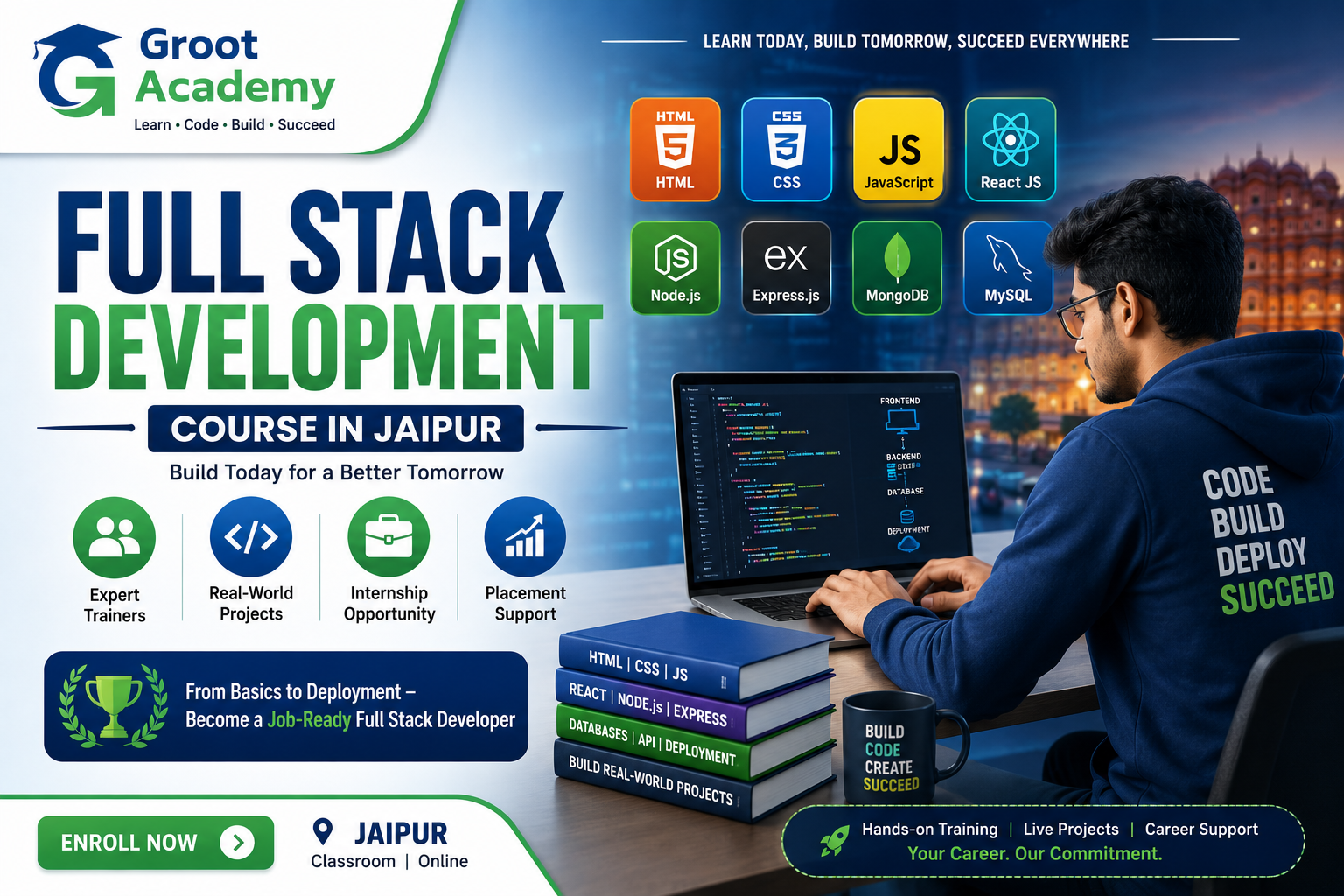
The primary JavaScript full stack path uses React, Node.js, Express and MongoDB, while the course also introduces relational database concepts, API design principles, version control and deployment fundamentals that transfer to other full stack technologies.
Who can join?
Beginners who want a structured path from web fundamentals to complete application development College students who need practical projects alongside programming concepts Frontend learners who want to add backend, APIs and database skills Backend learners who want to understand browser-side application development Developers preparing a stronger project portfolio for internships and entry-level roles
Connect the interface, server and database
Follow a learning path from browser foundations to a deployed application you can explain.
Frontend to backend
Connect HTML, CSS, JavaScript and React interfaces with Node.js services, APIs and persistent data.
Portfolio practice
Use Git, documentation, testing and deployment to turn project work into a clear technical demonstration.
Explore learner journeys
Visit Groot Academy's alumni directory to explore learner profiles. Ask the course team for examples relevant to your learning goals.
Explore alumni profilesFind a schedule that fits your week
Tell us your preferred timing. Confirm the next start date, session schedule, duration, learning mode and complete fee details with the course team.
Weekday preference
Ask about current weekday availability and the practice time to plan between sessions.
Ask about weekdaysWeekend preference
Ask whether a weekend batch is available and how its timetable fits your work or studies.
Ask about weekendsDiscuss how you will learn
Ask who will teach your selected batch, which technologies they cover and how project reviews and doubt sessions will work.
Questions for your course discussion
- Which trainer handles frontend and backend modules?
- How are coding assignments reviewed?
- What help is available when a project gets stuck?
- Can I discuss a sample lesson before enrolling?
Skills and tools
Course curriculum
Explore the published learning outline below. Confirm the detailed syllabus and module coverage for your chosen batch with the course team.
Web Foundations
How browsers, servers, HTTP and web applications work · Semantic HTML structure and accessible markup · CSS selectors, box model, flexbox, grid and responsive layouts · Forms, tables, media and reusable page structure
JavaScript Programming
Variables, data types, operators and control flow · Functions, arrays, objects and modern ES syntax · DOM manipulation, events and browser APIs · Promises, async/await, fetch and error handling · Modules and reusable JavaScript structure
React Frontend Development
Components, JSX, props and state · Hooks and component lifecycle concepts · Forms, validation and controlled inputs · Routing and multi-page application flow · API consumption, loading states and error states · Reusable UI patterns and project structure
Node.js & Express Backend
Node.js runtime, modules and package management · Express application structure, routes and middleware · REST API design and HTTP status codes · Request validation and centralized error handling · Environment configuration and backend project organization
Databases & Data Modelling
Database fundamentals and data modelling · MongoDB documents, collections and CRUD operations · Connecting Node.js applications to a database · Relational database and SQL concepts · Data validation, relationships and application-level data flow
Authentication & Application Security
Registration and login workflows · Authentication workflows and protected routes · Authentication state and session concepts · Authorization and protected-resource concepts · Input validation, secure configuration and common web security awareness
Full Stack Integration
Connecting React applications to backend APIs · End-to-end CRUD workflows · Authentication between frontend and backend · Error handling across the complete application · Validated form and application data workflows · Tracing data flow across frontend, API and database layers
Git, Testing & Debugging
Git repositories, commits, branches and merge workflow · Using GitHub for project history and collaboration · Browser developer tools and network debugging · Backend logging and API testing · Testing strategy fundamentals for frontend and backend
Deployment & Production Readiness
Environment variables and production configuration · Frontend build and backend deployment concepts · Database connection and environment configuration · Frontend and backend hosting fundamentals · Deployment checklists and production-oriented configuration · Testing, debugging and release-verification fundamentals
Portfolio & Interview Preparation
Structuring projects for a developer portfolio · Writing useful README and project documentation · Explaining architecture, APIs and database choices · Full stack interview topic revision · Debugging and project discussion practice
Project practice ideas
Use these examples to discuss suitable practice work with your trainer.
Responsive business website with reusable sections and mobile-first layout
Use this as a practical project brief to plan, build, test and document your work.
React dashboard that consumes and displays API data
Use this as a practical project brief to plan, build, test and document your work.
Node.js and Express REST API with validation and structured error handling
Use this as a practical project brief to plan, build, test and document your work.
Database-backed CRUD application for products, students, inventory or similar business data
Use this as a practical project brief to plan, build, test and document your work.
Authentication project with registration, login and protected application areas
Use this as a practical project brief to plan, build, test and document your work.
Full stack admin dashboard connecting React, backend APIs and a database
Use this as a practical project brief to plan, build, test and document your work.
E-commerce-style capstone with product catalogue, cart, user accounts and order workflow
Use this as a practical project brief to plan, build, test and document your work.
End-to-end portfolio capstone planned, built, tested, documented and prepared for deployment
Use this as a practical project brief to plan, build, test and document your work.
Understand certification and career support
Before enrolling, confirm certificate eligibility, assessment requirements and the support included in your chosen batch.
Completion requirements
Ask about attendance, assignments, project assessment, certificate issuer and how completion is verified.
Prepare to explain your work
The published learning path includes portfolio documentation and technical interview practice. Confirm any additional resume, mock interview or placement assistance offered for your batch.
Frequently asked questions
What is taught in the Full Stack Developer Course in Jaipur?
The course covers HTML, CSS, JavaScript, React, Node.js, Express, REST APIs, databases, authentication, Git, debugging and deployment fundamentals through connected project work.
Do I need prior programming experience?
No. The learning path starts with web and JavaScript fundamentals before moving into frontend frameworks, backend development and databases. Regular coding practice is important as the course progresses.
Is MERN Stack included in this course?
Yes. MongoDB, Express, React and Node.js form the main JavaScript full stack path, while additional database and deployment concepts are included to build a broader development foundation.
Will I build real full stack projects?
Yes. Project work progresses from responsive websites and API-driven interfaces to database-backed applications, authentication flows, dashboards and a complete capstone.
Does the course cover both frontend and backend development?
Yes. Frontend topics include HTML, CSS, JavaScript and React. Backend topics include Node.js, Express, APIs, data handling, validation, authentication and database integration.
Are databases included?
Yes. MongoDB is used in the primary JavaScript stack, and relational database concepts are also introduced so students understand different approaches to storing and modelling application data.
Are Git and deployment covered?
Yes. Students learn Git and GitHub workflow, environment configuration, debugging and the core concepts required to prepare frontend, backend and database components for deployment.
Is this course suitable for non-computer-science students?
Yes. Learners from other academic backgrounds can start from fundamentals. Consistent practice and completing the assigned projects are more important than having a specific degree.
What is the difference between this course and the MERN Stack course?
This is the broader full stack pathway. MERN is a specialist JavaScript stack focused on MongoDB, Express, React and Node.js. Learners who specifically want that stack can use the dedicated MERN course page.
Can I choose Java or Python full stack instead?
Groot Academy also has dedicated Java Full Stack and Python Full Stack learning paths. Those pages are better suited to students who specifically want Java or Python for backend development.
Who is this course for?
Beginners who want a structured path from web fundamentals to complete application development College students who need practical projects alongside programming concepts Frontend learners who want to add backend, APIs and database skills Backend learners who want to understand browser-side application development Developers preparing a stronger project portfolio for internships and entry-level roles
How can I confirm fees, duration and batch timings?
Contact Groot Academy for the current syllabus, fees, duration and available learning modes before enrolling. These details depend on the selected course and batch.
Ready to discuss Full Stack Developer?
Ask the course team about syllabus coverage, current batch timings, fees, duration and learning modes before you decide.