

Java vs Python: A Practical Comparison for Beginners
Choose a first language by comparing how Java and Python feel to write, run and use in a small project.
Start with the problem you want to solve
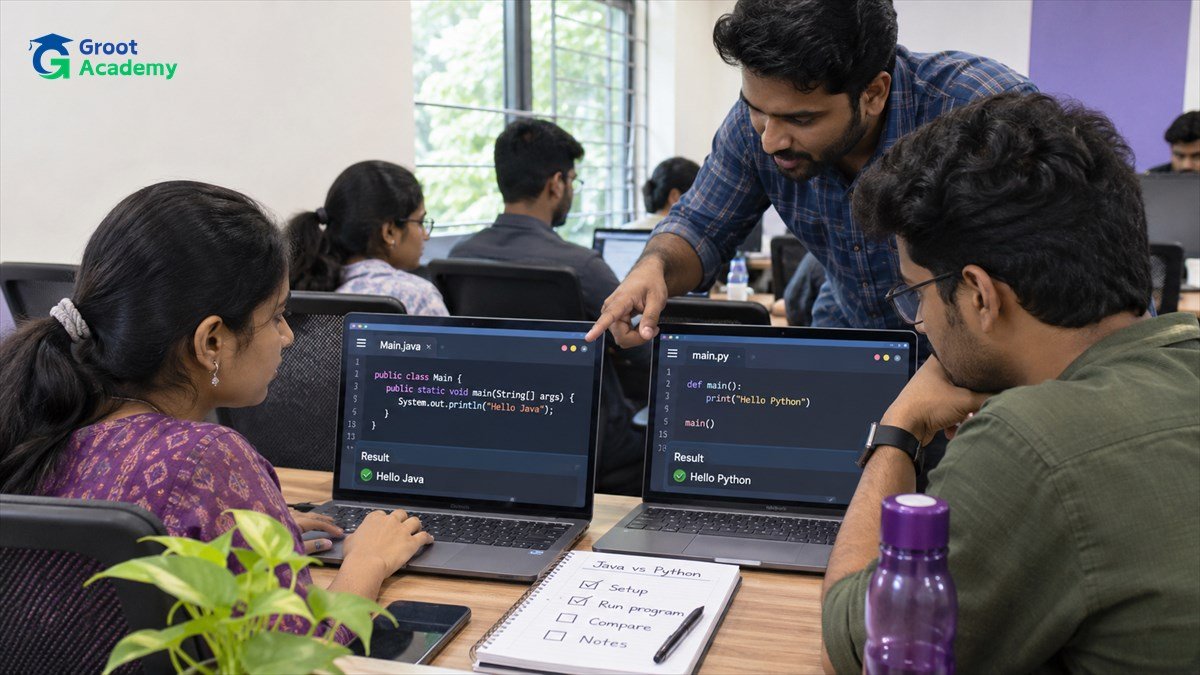
Java and Python can both teach the programming habits that matter: describing a problem, choosing data, writing clear steps, checking edge cases and improving a working program. A first-language decision is most useful when it is tied to a project you want to make or a codebase you need to understand.
There is no universal winner. Python can make early experiments feel compact, while Java makes types, classes and program structure visible from the beginning. Either choice can be a sound starting point when you practise consistently and return to the fundamentals.
Syntax and program structure
Python uses indentation to group blocks of code and usually lets a small program be expressed with relatively little setup. Its readable style can help a beginner focus on values, conditions, loops and functions before handling more structure.
Java programs commonly make more structure explicit. A learner encounters classes, methods and declared types early, then uses the same ideas in larger applications. That extra structure can be useful practice when you want to reason carefully about a program's model and boundaries.
| Question | Java | Python |
|---|---|---|
| How are types handled? | Variables and method signatures normally declare their types, allowing many mismatches to be found before running the program. | Values carry types at runtime; optional type annotations can make an interface clearer. |
| How is a program organized? | Classes and methods are central from the first examples onward. | Small scripts can begin with functions and modules, then use classes when the model benefits from them. |
| What should a beginner practise? | Methods, objects, collections, exceptions and tests in a small command-line program. | Functions, collections, files, exceptions and tests in a small script or utility. |
Neither style removes the need to read error messages, name things clearly or break a problem into small pieces. Those habits matter more than memorising syntax.
Runtime and execution models
Java source is compiled into bytecode that runs on the Java Virtual Machine (JVM). The JVM gives Java programs a consistent execution environment across supported systems and is central to the Java ecosystem.
Python programs are usually run by a Python interpreter. This supports quick experimentation and interactive work, while individual programs can still be packaged, tested and deployed with deliberate engineering choices.
Runtime speed is a property of a particular workload, algorithm, libraries, input size and deployment environment. If performance matters, first make the behaviour correct, measure the important operation and investigate the result rather than choosing a language from a general ranking.
Common application contexts
Java is frequently encountered in JVM-based backend services, long-lived business applications and Android codebases. Python is commonly used for automation, data-oriented work, scientific computing, scripting and web backends. Both can support server-side applications, APIs, tests and command-line tools.
These contexts overlap. A team can use Python for a supporting data task and Java for a service, or make a different choice based on its existing systems and maintainers. Treat a language ecosystem as context for a problem, not a guarantee about a project or outcome.
Choose a first practice path
| If you want to practise... | A sensible first step |
|---|---|
| Quick scripts, file processing or data exploration | Start with Python variables, collections, functions and file handling; build a small utility using fictional inputs. |
| Explicit object-oriented structure or a Java codebase | Start with Java syntax, methods, classes, collections and exceptions; build a small record-management program. |
| Backend development in either language | Learn HTTP, validation, data models, access boundaries and tests after the core language foundation. |
| Problem solving | Use either language to implement the same small algorithms, then explain the data structure and test cases you chose. |
Keep the first project deliberately small. A task tracker, reading log, expense summary or fictional library catalogue can reveal how a language handles input, state, validation, files and errors without requiring private data or a large framework.
The maintained Python Programming path and Java learning paths can help you identify the next foundation topic after that project.
Skills that transfer between Java and Python
Learning one language does not make the other inaccessible. Conditions, loops, functions, collections, algorithms, debugging, tests and version control carry across. The syntax changes, but the work of defining an input, choosing a representation, checking an output and explaining a trade-off remains useful.
Keep a short README for each project that states its purpose, sample data, how to run it, the checks you made and what you would improve next. The Git and GitHub guide and practical skills roadmap explain how to make that record useful.
Frequently asked questions
Should I learn Python before Java?
You can, especially if a compact scripting or data project keeps you engaged. You can also begin with Java when a class, project or existing codebase calls for it. Build basic programming habits before treating either order as permanent.
Is Java always faster than Python?
Do not use a broad language label as a performance result. Measure the important workload after you have a correct program, then examine the algorithm, data handling, libraries and runtime environment.
Do I need to learn both languages?
No. Depth in one language and solid programming fundamentals are useful. A second language can be a good later exercise when it helps you understand a different ecosystem or a new kind of project.
Build programming foundations deliberately
Choose one small project, test it, explain its trade-offs and then decide what to learn next.
Explore Java learning paths