


Using Artificial Intelligence as a Productivity Partner Instead of a Dependency
Artificial Intelligence is rapidly changing the way software is developed. Modern AI tools can generate code, explain concepts, create documentation, write tests, suggest fixes, and even build entire applications from prompts.
For developers, this presents both an opportunity and a challenge.
The opportunity is obvious: AI can dramatically increase productivity and reduce repetitive work.
The challenge is equally important: relying too heavily on AI can weaken the very skills that make developers valuable in the first place.
Many students today are learning programming with AI assistance from day one. While this can accelerate learning, it can also create dependency if used incorrectly.
The goal should not be to avoid AI.
The goal should be to use AI effectively while continuing to develop strong engineering fundamentals.
Why AI is Transforming Software Development
AI tools can help developers:
- Generate Code
- Explain Concepts
- Create Documentation
- Debug Errors
- Write Unit Tests
- Refactor Applications
Tasks that once took hours can often be completed in minutes.
This allows developers to focus on higher-value activities.
However, AI is most valuable when it enhances skills rather than replaces learning.
The Risk of AI Dependency
Many developers fall into a dangerous pattern:
- Ask AI for a solution.
- Copy the code.
- Paste it into the project.
- Move to the next task.
Without understanding:
- Why the code works
- How it solves the problem
- What trade-offs exist
This approach may produce working software but limits long-term growth.
Developers become operators rather than engineers.
Why Fundamentals Still Matter
Programming languages, frameworks, and AI tools evolve constantly.
Fundamental concepts remain valuable for decades.
Examples include:
- Logic
- Algorithms
- Data Structures
- Databases
- Networking
- Operating Systems
- Software Design
- System Architecture
These concepts help developers understand software at a deeper level.
AI can assist implementation, but understanding remains a human responsibility.
AI Should Accelerate Learning, Not Replace It
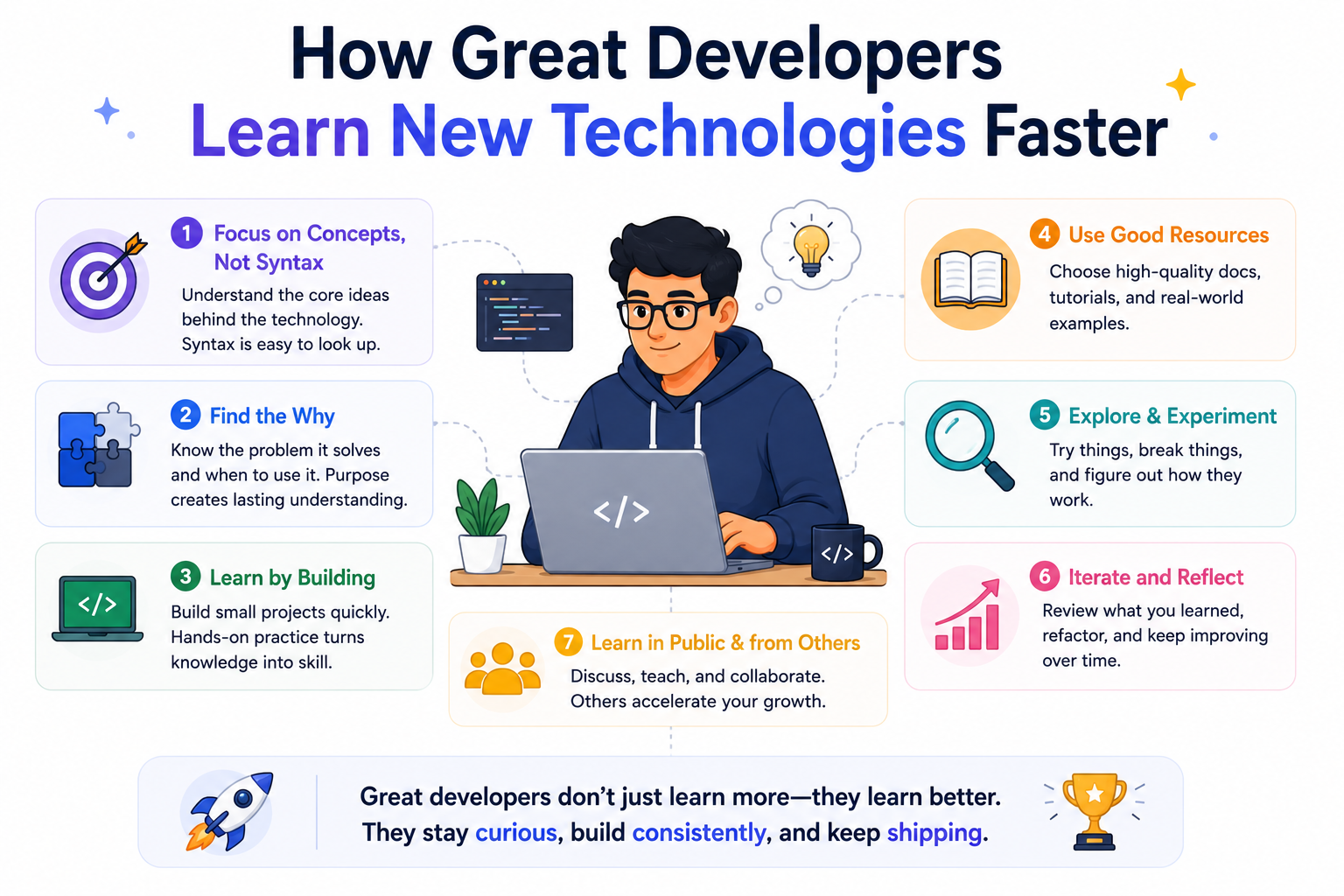
The best developers use AI as a mentor and assistant.
Instead of asking:
“Write the entire solution.”
Ask:
- Why is this approach used?
- What are the alternatives?
- What is the time complexity?
- How can this be optimized?
This transforms AI into a learning tool.
Learn the Problem Before Using AI
A common mistake:
Students immediately ask AI for code.
A better approach:
Step 1
Understand the problem.
Step 2
Design a solution.
Step 3
Attempt implementation.
Step 4
Use AI to improve your approach.
This process strengthens problem-solving skills.
Always Review AI-Generated Code
Never assume AI-generated code is correct.
Developers should review:
- Logic
- Security
- Performance
- Maintainability
AI can generate functional code that contains:
- Bugs
- Security Risks
- Inefficient Algorithms
Critical thinking remains essential.
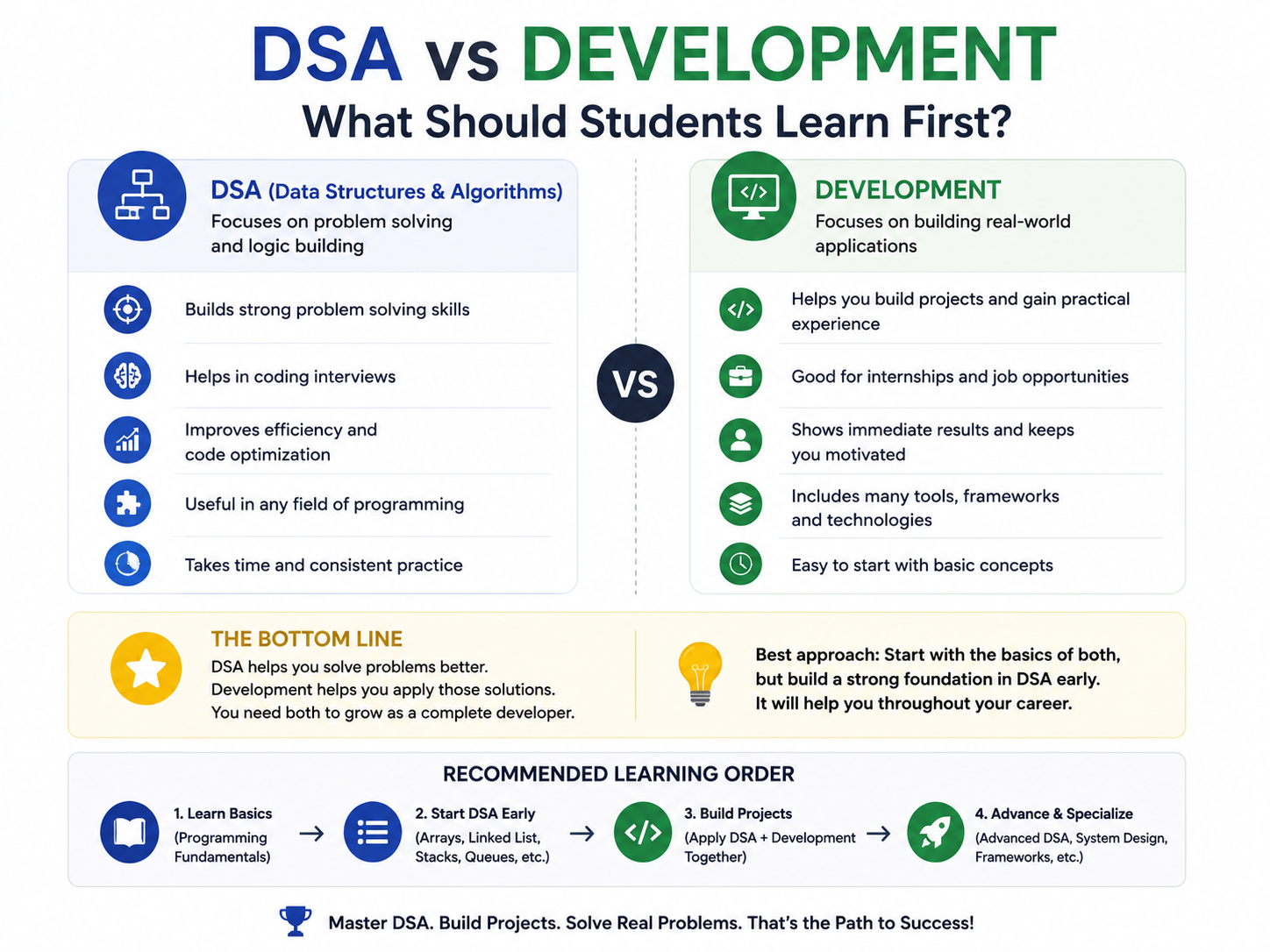
Continue Practicing Data Structures and Algorithms
One area where dependency often develops is DSA practice.
Many students now use AI to solve coding problems instantly.
This reduces learning.
Instead:
Solve First
Attempt the problem independently.
Compare Later
Review AI-generated approaches afterward.
Learn Alternatives
Study multiple solutions.
This method improves understanding.
Use AI to Learn System Design
System design is difficult to automate completely.
Developers can use AI to:
- Explore Architectures
- Understand Design Patterns
- Compare Approaches
But they should still make final engineering decisions themselves.
Architecture develops through experience and reasoning.
Don’t Skip Debugging
When code fails, many developers immediately ask AI for fixes.
Instead:
Investigate Logs
Understand the error.
Analyze the Problem
Identify the root cause.
Use AI as Support
Verify findings and explore solutions.
Debugging develops analytical thinking.
This skill remains highly valuable.
Build Projects Without AI Occasionally
One of the best ways to measure skill growth is to build projects independently.
Try:
- Small Applications
- APIs
- Portfolio Projects
- Automation Tools
without relying heavily on AI.
This reveals knowledge gaps and strengthens confidence.
Understand the Code You Ship
Professional developers are responsible for their software.
Before deploying code:
Ask yourself:
- Can I explain how this works?
- Can I modify it later?
- Can I debug it if it fails?
If the answer is no, deeper understanding is needed.
AI Cannot Replace Engineering Judgment
Engineering decisions involve:
- Trade-Offs
- Scalability
- Security
- Performance
- Business Goals
AI can provide suggestions.
Developers must evaluate them.
Judgment remains a human skill.
Continue Learning Core Computer Science Concepts
Students should continue studying:
Data Structures
Efficient data organization.
Algorithms
Efficient problem solving.
Databases
Data management.
Networking
System communication.
Operating Systems
Software execution.
Software Architecture
System design.
These fundamentals remain valuable regardless of AI advancements.
Use AI for Repetitive Tasks
AI is especially useful for:
Documentation
Creating explanations.
Boilerplate Code
Generating repetitive structures.
Unit Tests
Writing initial test cases.
Refactoring
Improving code readability.
Research
Exploring technologies quickly.
These tasks provide excellent opportunities for productivity gains.
Learn Prompt Engineering Responsibly
Developers should learn how to ask effective questions.
Good prompts include:
- Context
- Requirements
- Constraints
- Expected Outcomes
However, prompt engineering should complement technical knowledge, not replace it.
Why Strong Fundamentals Make AI More Powerful
Two developers use the same AI tool.
Developer A
Strong fundamentals.
Can evaluate and improve AI output.
Developer B
Weak fundamentals.
Accepts AI output blindly.
Developer A gains far more value.
AI amplifies existing skill levels.
The Future of Software Engineering
As AI becomes more capable, developers will spend less time writing repetitive code and more time:
- Designing Systems
- Solving Problems
- Understanding Users
- Building Products
- Making Engineering Decisions
The role of software engineers will evolve rather than disappear.
Common Mistakes Developers Make
Blind Copy-Pasting
Without understanding.
Avoiding Problem Solving
Letting AI think for them.
Ignoring Fundamentals
Focusing only on tools.
Trusting AI Completely
Without verification.
Skipping Debugging
Missing valuable learning opportunities.
Avoiding these habits preserves long-term growth.
Best Practices for AI-Assisted Development
Learn First, Ask Later
Attempt solutions independently.
Verify Everything
Review AI-generated output.
Keep Practicing Fundamentals
Maintain strong foundations.
Build Independent Projects
Develop confidence.
Use AI as a Mentor
Not a replacement.
Continue Learning
Technology and AI will continue evolving.
These habits create stronger engineers.
Frequently Asked Questions
Should developers use AI?
Yes. AI is a powerful productivity tool when used correctly.
Can AI replace programming fundamentals?
No. Fundamentals remain essential for understanding and evaluating solutions.
Is it okay to use AI for coding interviews?
Developers should first build independent problem-solving abilities.
What skill remains most important?
Problem solving and engineering judgment.
Conclusion
AI is one of the most powerful tools ever introduced into software development. It can accelerate learning, improve productivity, reduce repetitive work, and help developers build software faster than ever before.
However, developers must avoid becoming dependent on AI. Strong fundamentals, problem-solving skills, system design knowledge, debugging abilities, and engineering judgment remain essential.
The most successful developers will not be those who avoid AI, nor those who blindly rely on it. They will be the professionals who combine strong computer science foundations with intelligent use of AI tools.
In the future, AI will not replace skilled developers—it will amplify them.
🌐 Website: https://grootacademy.com
📺 YouTube: https://www.youtube.com/@YourGrootAcademy
📘 Facebook: http://facebook.com/GrootAcademy
📸 Instagram: https://www.instagram.com/groot.academy/
🐦 X: https://x.com/GrootAcademy
💼 LinkedIn: https://www.linkedin.com/company/grootacademy
📌 Pinterest: https://in.pinterest.com/mygrootacademy/