
Artificial Intelligence Course in Jaipur
Build a broad foundation in Artificial Intelligence, from Python and data preparation to evaluated machine-learning models, neural networks, text and image applications. The course also introduces Generative AI and deployment; focused Data Science and Generative AI paths offer related study options.
- Practical learning
- Project practice
- Jaipur
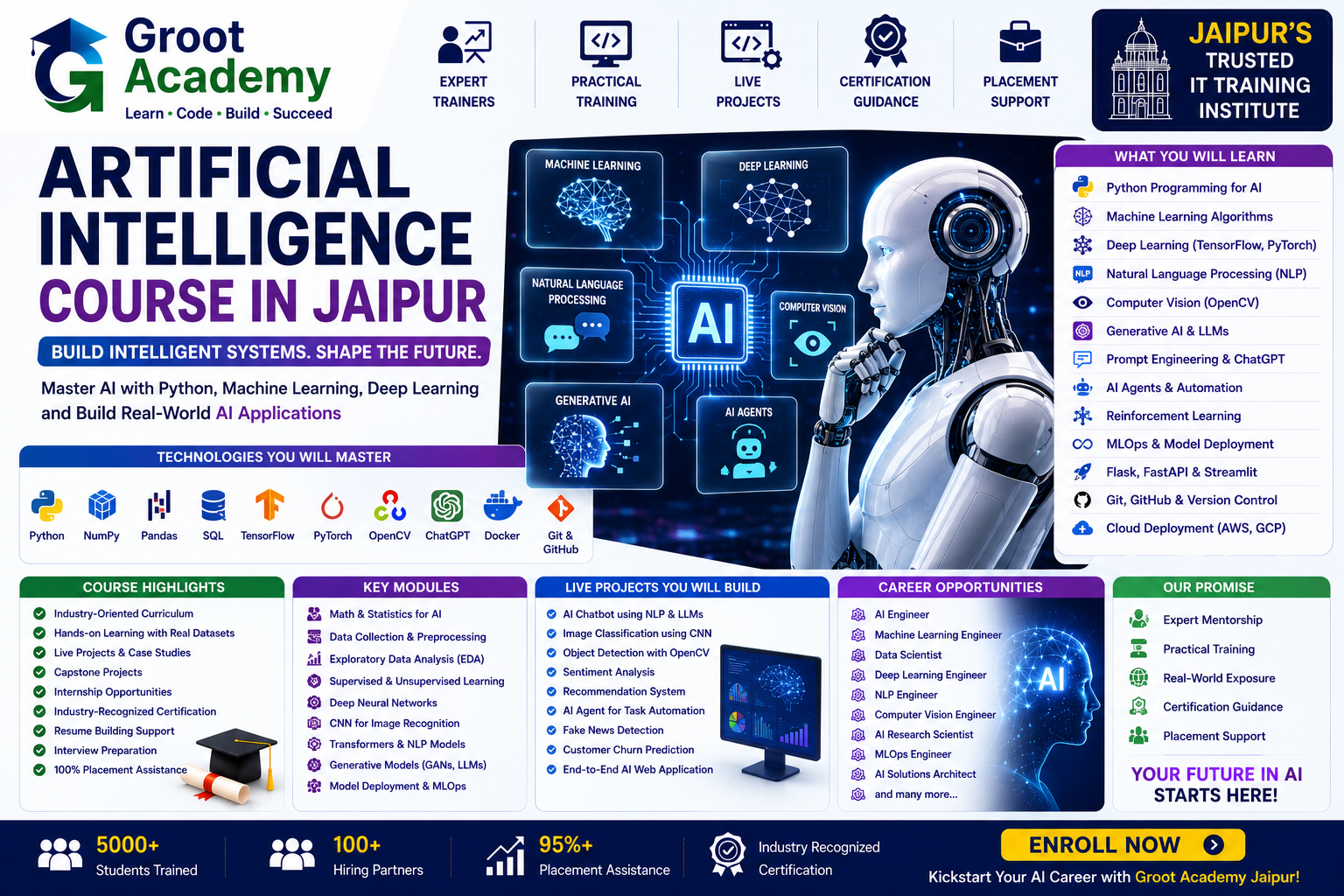
Artificial Intelligence
Build your foundation in Artificial Intelligence
Build a broad foundation in Artificial Intelligence, from Python and data preparation to evaluated machine-learning models, neural networks, text and image applications. The course also introduces Generative AI and deployment; focused Data Science and Generative AI paths offer related study options.
Start by framing a problem in terms of inputs, outputs, constraints and measurable success criteria. Work through Python, mathematics and data preparation before selecting and evaluating models.
The curriculum connects supervised and unsupervised learning to deep learning, Natural Language Processing and computer vision. Projects help you document the data, modelling choices and limitations rather than judge an application by its output alone.
Later topics introduce Generative AI, prediction APIs, model monitoring and responsible use. The related Generative AI course goes further into LLM applications, while the Data Science and Machine Learning course emphasizes analysis and predictive modelling workflows.
Who can join?
Students, graduates and professionals who want a structured introduction to AI. Basic Python and school-level mathematics are helpful before moving into model-building topics.
Skills and tools
Course curriculum
Explore the published learning outline below. Confirm the detailed syllabus and module coverage for your chosen batch with the course team.
Introduction to Artificial Intelligence
Understand AI terminology, common problem types, intelligent systems and how AI, machine learning and data science relate.
- Introduction to Artificial Intelligence
- History and Evolution of AI
- Types of Artificial Intelligence
- Narrow AI vs General AI
- Artificial Intelligence vs Machine Learning
- Artificial Intelligence vs Data Science
- Real-World Applications of AI
- AI Industry and Career Opportunities
- Understanding Intelligent Systems
- Setting Up the AI Learning Environment
Python for Artificial Intelligence
Use Python collections, functions, NumPy and Pandas to load and work with datasets.
- Introduction to Python for AI
- Python Variables and Data Types
- Conditional Statements and Loops
- Functions and Modules
- Lists, Tuples, Sets and Dictionaries
- NumPy Fundamentals
- Working with NumPy Arrays
- Pandas Fundamentals
- Working with DataFrames
- Loading and Processing Datasets
- Functions and OOP
- File Handling
- APIs and JSON
- Data Structures and Algorithms
- Matplotlib
- Automation with Python
Mathematics and Statistics for AI
Review vectors, matrices, probability, distributions and statistics before modelling.
- Introduction to Mathematics for AI
- Linear Algebra Fundamentals
- Vectors and Matrices
- Matrix Operations
- Probability Fundamentals
- Statistics for AI
- Mean, Variance and Standard Deviation
- Probability Distributions
- Correlation and Covariance
- Mathematics and Statistics Practice
- Calculus Basics
Data Preparation for AI
Clean datasets, encode inputs, scale features and prepare a usable modelling dataset.
- Understanding AI Datasets
- Data Collection and Data Sources
- Data Cleaning
- Handling Missing Values
- Handling Duplicate Data
- Encoding Categorical Data
- Feature Scaling
- Normalization and Standardization
- Feature Selection and Engineering
- Data Preparation Project
Machine Learning Fundamentals
Frame a task, separate training and test data and recognize overfitting and underfitting.
- Introduction to Machine Learning
- Types of Machine Learning
- Supervised Learning
- Unsupervised Learning
- Reinforcement Learning Overview
- Machine Learning Workflow
- Training and Testing Data
- Overfitting and Underfitting
- Introduction to Scikit-learn
- Machine Learning Fundamentals Project
Supervised Learning Algorithms
Compare regression and classification methods using suitable evaluation measures.
- Introduction to Supervised Learning
- Linear Regression
- Logistic Regression
- Decision Trees
- Random Forest
- K-Nearest Neighbors
- Naive Bayes
- Support Vector Machines
- Model Evaluation
- Supervised Learning Project
Unsupervised Learning Algorithms
Use clustering and dimensionality reduction to explore patterns and document their interpretation.
- Introduction to Unsupervised Learning
- Clustering Concepts
- K-Means Clustering
- Hierarchical Clustering
- DBSCAN Overview
- Dimensionality Reduction
- Principal Component Analysis
- Customer Segmentation
- Cluster Evaluation
- Unsupervised Learning Project
Deep Learning Fundamentals
Study neural-network layers, activations, loss functions and optimization with TensorFlow and Keras.
- Introduction to Deep Learning
- Artificial Neural Networks
- Neurons and Activation Functions
- Forward Propagation
- Backpropagation
- Loss Functions
- Optimizers
- Introduction to TensorFlow
- Introduction to Keras
- Building Your First Neural Network
Advanced Deep Learning
Explore convolutional and recurrent networks, transfer learning, validation and tuning.
- Introduction to Convolutional Neural Networks
- Image Data and CNN Architecture
- CNN Layers and Filters
- Introduction to Recurrent Neural Networks
- Sequence Data
- LSTM Networks
- Transfer Learning
- Model Training and Validation
- Hyperparameter Tuning
- Deep Learning Project
- PyTorch
- GPU Training
- Speech Recognition
Natural Language Processing
Prepare text inputs and practise sentiment analysis and text classification.
- Introduction to Natural Language Processing
- Text Data Collection
- Text Cleaning and Preprocessing
- Tokenization
- Stop Words and Stemming
- Text Vectorization
- Bag of Words and TF-IDF
- Sentiment Analysis
- Text Classification
- NLP Project
Computer Vision
Work with image inputs, OpenCV and image-recognition concepts, including classification, detection and segmentation.
- Introduction to Computer Vision
- Understanding Image Data
- Image Preprocessing
- Image Classification
- Object Detection Concepts
- Image Segmentation Concepts
- OpenCV Fundamentals
- Building Image Recognition Models
- Computer Vision Applications
- Computer Vision Project
- Facial Recognition
- OCR Systems
- Real-Time Vision Systems
Generative AI Fundamentals
Introduce language models, transformers and prompt engineering while recognizing limitations and responsible-use needs.
- Introduction to Generative AI
- Generative AI vs Traditional AI
- Understanding Large Language Models
- Introduction to Transformers
- Prompt Engineering Fundamentals
- AI Content Generation
- AI Image Generation Concepts
- AI-Powered Applications
- Responsible Generative AI
- Generative AI Mini Project
AI Model Deployment
Save models, create a prediction API, test application integration and explore deployment and monitoring concepts.
- Introduction to AI Model Deployment
- Saving Trained Models
- Pickle and Joblib
- Creating AI Prediction APIs
- Introduction to Flask
- Integrating AI Models with Applications
- API Testing
- Introduction to Cloud Deployment
- AI Model Monitoring Concepts
- AI Deployment Project
- Docker
- Kubernetes
- CI/CD
- AI Architecture
- Feature Stores
- Model Versioning
- AI Infrastructure Design
- Distributed Systems
- AI Scalability
AI Ethics and Responsible AI
Identify bias, privacy, explainability, security and governance concerns, and recognize where human review is necessary.
- Introduction to AI Ethics
- AI Bias and Fairness
- Data Privacy in AI
- Responsible AI Development
- Explainable AI Concepts
- AI Security Fundamentals
- Ethical AI Decision Making
- AI Governance Concepts
- Legal and Social Impact of AI
- Responsible AI Best Practices
AI Live Projects and Capstone
Combine data preparation, modelling, evaluation and deployment in a practical project with documented limitations.
- AI-Based Prediction Project
- Customer Churn Prediction
- Image Classification Project
- Sentiment Analysis Project
- NLP Chatbot Project
- Computer Vision Application
- Generative AI Application
- AI Model Deployment Project
- End-to-End Artificial Intelligence Project
- Final Artificial Intelligence Capstone Project
- Fraud Detection
- Recommendation Systems
- AI SaaS Platforms
- AI Portfolio Development
Project practice ideas
Use these examples to discuss suitable practice work with your trainer.
AI classification prototype
Prepare a small dataset, train a simple model and explain the evaluation results.
Applied AI case study
Define an AI problem for a practical domain and document the data, model choice, risks and success criteria.
Image classification project
Prepare a practice image dataset, train or adapt a model and report validation results and limitations.
Sentiment analysis project
Prepare text data, compare classification results and document the effects of preprocessing and dataset choices.
AI model deployment project
Expose a saved model through a prediction API, test representative inputs and describe monitoring needs.
Final Artificial Intelligence capstone
Define an end-to-end AI problem, justify the data and model choices, evaluate outputs and document responsible-use considerations.
Roles to explore
Build a portfolio and practise explaining your work. Role requirements depend on the employer, your skills and experience.
- AI trainee
- Machine learning intern
- Junior AI application developer
Frequently asked questions
How is this Artificial Intelligence course different from Data Science?
Artificial Intelligence focuses on building systems that perform tasks such as prediction, classification and decision support. Data Science includes broader data preparation, analysis, statistics and modelling workflows.
How is this different from Generative AI?
This course covers broad AI and machine-learning foundations. Generative AI focuses more specifically on language models, prompting, retrieval and AI-assistant applications.
What should I know before starting the modelling topics?
Basic Python and school-level mathematics are helpful. Python, linear algebra, probability and statistics foundations are included before data preparation and modelling.
Are text and image applications included?
Yes. Natural Language Processing includes text preparation, sentiment analysis and classification. Computer vision topics introduce image preprocessing, classification, detection, segmentation and OpenCV.
Does the course cover deployment?
Yes. Later topics cover saving models, prediction APIs, Flask integration, API testing, cloud deployment and monitoring concepts.
How is responsible AI covered?
The curriculum includes bias, privacy, explainability, security and governance. Project work should record limitations and situations that require human review.
Who is this course for?
Students, graduates and professionals who want a structured introduction to AI. Basic Python and school-level mathematics are helpful before moving into model-building topics.
How can I confirm fees, duration and batch timings?
Contact Groot Academy for the current syllabus, fees, duration and available learning modes before enrolling. These details depend on the selected course and batch.
Ready to discuss Artificial Intelligence?
Ask the course team about syllabus coverage, current batch timings, fees, duration and learning modes before you decide.