


Ethical Hacking Course in Jaipur
Follow a practical security-learning path that begins with networking, Linux and authorization, then progresses through reconnaissance, vulnerability assessment, web and cloud security, monitoring, responsible reporting and retesting.
- Practical learning
- Project practice
- Jaipur
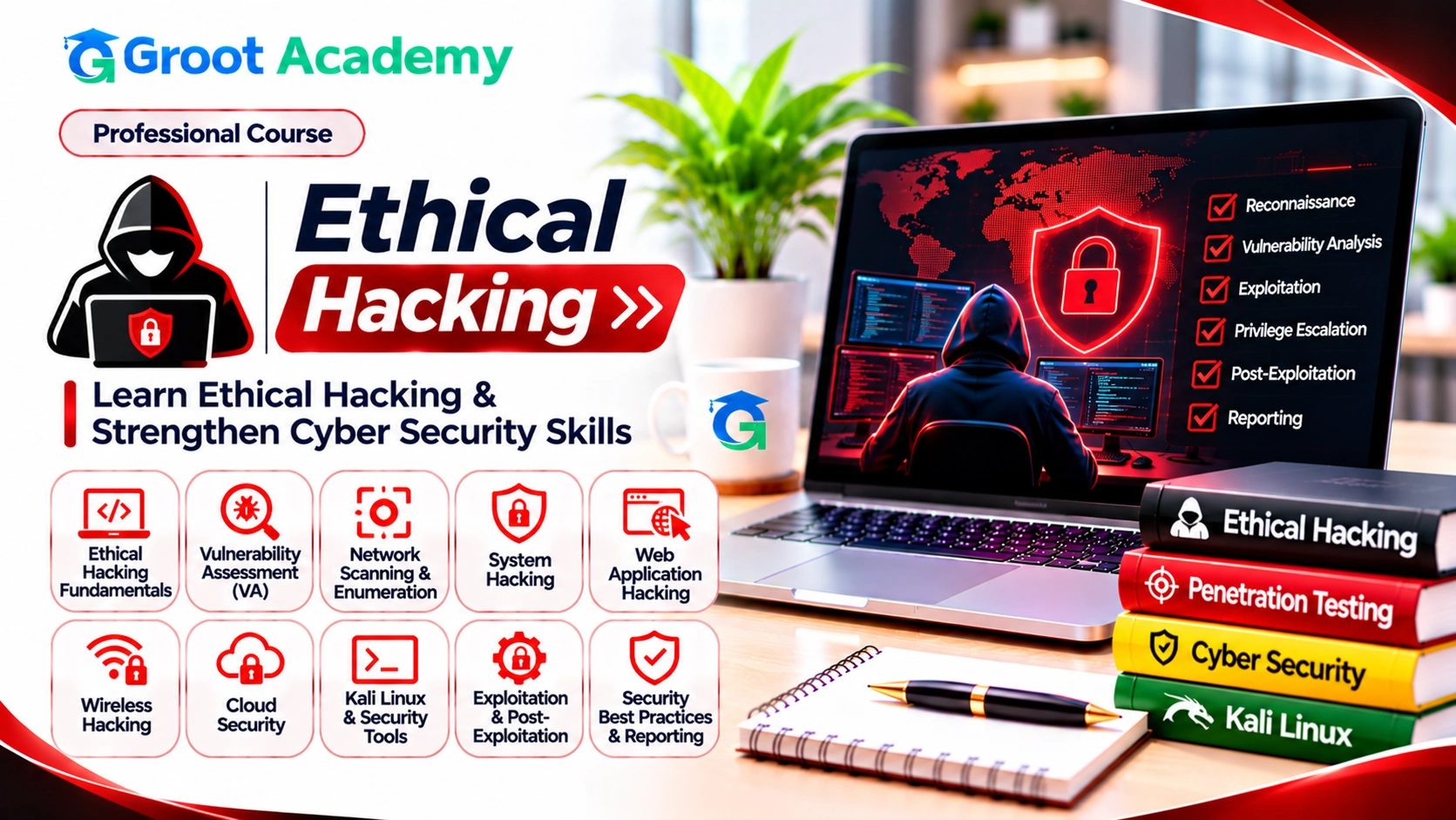
Ethical Hacking
Build your foundation in Ethical Hacking
Follow a practical security-learning path that begins with networking, Linux and authorization, then progresses through reconnaissance, vulnerability assessment, web and cloud security, monitoring, responsible reporting and retesting.
Who can join?
Students and IT learners starting in ethical hacking. Networking and Linux foundations are helpful; all practice must stay within a legal lab or explicitly authorized scope.
Skills and tools
Course curriculum
Explore the published learning outline below. Confirm the detailed syllabus and module coverage for your chosen batch with the course team.
Security foundations and lab safety
Study security controls, rules of engagement and the setup of a legal practice environment.
- Introduction to Ethical Hacking and Cybersecurity
- Cybersecurity Threats Attacks and Security Controls
- Ethical Hacking Methodology and Rules of Engagement
- Setting Up a Legal Cybersecurity Lab Environment
Networking, Linux and reconnaissance
Build foundations in TCP/IP, DNS, HTTP/S, ports, protocols and Linux, then study passive and active OSINT concepts.
- Networking Fundamentals TCP IP DNS HTTP and HTTPS
- Ports Protocols Firewalls and Network Services
- Linux Fundamentals for Security Professionals
- Linux Commands Permissions Processes and Networking
- Passive Reconnaissance and Open Source Intelligence
- Active Reconnaissance and Network Discovery
- DNS Enumeration and Subdomain Discovery
- Scanning Fundamentals with Nmap and Service Identification
Vulnerability assessment and hardening
Review CVE and CVSS, configuration assessment, controlled validation, remediation and responsible reporting.
- Vulnerability Concepts CVE CVSS and Risk Assessment
- Web Server and Network Vulnerability Assessment
- Configuration Review and Security Hardening
- Vulnerability Validation and Responsible Reporting
Web application and access security
Explore OWASP risks, authentication, sessions, access control and safe input-validation testing concepts.
- Web Application Architecture and Common Vulnerabilities
- OWASP Top 10 Security Risks
- Authentication Sessions and Access Control Security
- Input Validation XSS SQL Injection and Secure Testing
Network, wireless and endpoint defense
Study traffic analysis, wireless security fundamentals, endpoint controls, malware awareness and defensive monitoring.
- System Security Assessment and Privilege Concepts
- Network Security Testing and Traffic Analysis
- Wireless Security Fundamentals and Defensive Testing
- Password Security Hashing and Authentication Testing
- Security Monitoring Logging and Incident Detection
- SIEM Fundamentals and Security Event Analysis
Cloud, containers and security operations
Cover shared responsibility, AWS/Azure/Google Cloud concepts, Kubernetes security, identity access management, SIEM and incident response.
- Incident Response and Digital Forensics Fundamentals
- Endpoint Security Malware Awareness and Security Controls
- Cloud Security Fundamentals and Shared Responsibility
- AWS Azure and Google Cloud Security Concepts
- Container and Kubernetes Security Fundamentals
- Cloud Identity Access Management and Security Best Practices
Safe tools, assessment and reporting
Review the source-listed Burp Suite and Metasploit topics as controlled lab workflows, then plan authorized assessments and document remediation and retesting.
- Security Testing Tools and Safe Lab Workflows
- Metasploit Framework Concepts and Controlled Testing
- Burp Suite for Web Security Testing
- Writing Professional Penetration Testing Reports
- Planning a Legal Penetration Testing Engagement
- Conducting a Controlled Security Assessment
- Risk Prioritization Remediation and Retesting
Project and next steps
Complete the source-listed ethical-hacking project and prepare to explain the assessment process and its safety boundaries.
- Final Ethical Hacking Project and Interview Preparation
Project practice ideas
Discuss a suitable practice brief, tools and scope with the course team before working with live services or accounts.
Ethical hacking project
Plan a bounded lab assessment, record evidence, prioritize findings and present remediation and retesting steps.
Frequently asked questions
Quick answers about learning, projects, batches and the next step at Groot Academy.
Do I need networking or Linux experience?
The source syllabus teaches networking and Linux foundations, which are useful preparation for its later security topics.
Can I test public websites or networks?
Only when you have explicit authorization and a defined written scope. Otherwise, use a legal practice lab.
Does the course include cloud and container security?
Yes. The lesson titles include major cloud-provider concepts, container and Kubernetes security, and cloud identity access management.
Who is this course for?
Students and IT learners starting in ethical hacking. Networking and Linux foundations are helpful; all practice must stay within a legal lab or explicitly authorized scope.
How can I confirm fees, duration and batch timings?
Contact Groot Academy for the current syllabus, fees, duration and available learning modes before enrolling. These details depend on the selected course and batch.
What will I study in the Ethical Hacking course?
Follow a practical security-learning path that begins with networking, Linux and authorization, then progresses through reconnaissance, vulnerability assessment, web and cloud security, monitoring, responsible reporting and retesting.
Which skills and tools are covered in Ethical Hacking?
The published learning outline includes Networking and Linux foundations, OSINT and reconnaissance, Nmap and service identification concepts, Risk assessment, Web application security, Cloud and container security. See the skills section for the complete current outline and confirm the batch syllabus before joining.
What topics are included in the Ethical Hacking curriculum?
The listed modules include Security foundations and lab safety, Networking, Linux and reconnaissance, Vulnerability assessment and hardening, Web application and access security, Network, wireless and endpoint defense. Read the curriculum section for details; the delivery sequence can vary by batch.
What practical projects can I explore during Ethical Hacking?
The page lists practice ideas such as Ethical hacking project. Ask the course team which project activities are included in your particular batch.
How can I use Ethical Hacking projects in my portfolio?
Document the problem, the tools you used, the decisions you made and the result. Include working examples or a repository where appropriate, and explain your own contribution clearly.
Can a beginner start learning Ethical Hacking?
Compare the course prerequisites and learning outline with your current skills. Beginners can ask the team which foundations to practise first and whether the next batch is suitable for their level.
What should I prepare before a Ethical Hacking batch?
Review any stated prerequisites, plan regular practice time and ask which device, software and setup are required for the current batch.
Are online or classroom batches available for Ethical Hacking?
Delivery mode depends on the active course batch. Contact Groot Academy to check the current online, offline or hybrid options instead of assuming every mode is available.
How can I check the latest Ethical Hacking syllabus?
Review the published curriculum on this page and request the latest batch-specific outline from the course team. Topics or sequencing can change as the program is updated.
How much practice time should I plan for Ethical Hacking?
Set aside consistent time to review lessons, practise exercises and work on projects. The appropriate weekly commitment depends on your experience, selected batch and course scope.
Will I receive a certificate after Ethical Hacking?
Ask the course team about certificate availability, issuer, completion criteria and verification process for the specific batch. Do not assume a certificate is automatic for every program.
Does taking Ethical Hacking guarantee a job?
No course alone guarantees employment. A strong learning plan combines technical understanding, independent projects, communication, interviews and suitable opportunities.
Can I ask about assignments and assessments before joining Ethical Hacking?
Yes. Request the current batch learning plan and ask how exercises, project reviews, feedback and progress checks are organised.
What happens if I miss a Ethical Hacking class?
Make-up lessons, recordings and attendance rules depend on the batch policy. Confirm these arrangements directly before paying or enrolling.
How do I enquire or enrol in Ethical Hacking?
Use the enquiry form on the course page or contact Groot Academy. First confirm eligibility, current syllabus, schedule, fees and any applicable terms.
Ready to discuss Ethical Hacking?
Ask the course team about syllabus coverage, current batch timings, fees, duration and learning modes before you decide.