


SOC Analyst Course in Jaipur
Build a structured foundation in security operations: collect and investigate telemetry, triage alerts, support incident response, and document evidence and findings.
- Practical learning
- Project practice
- Jaipur
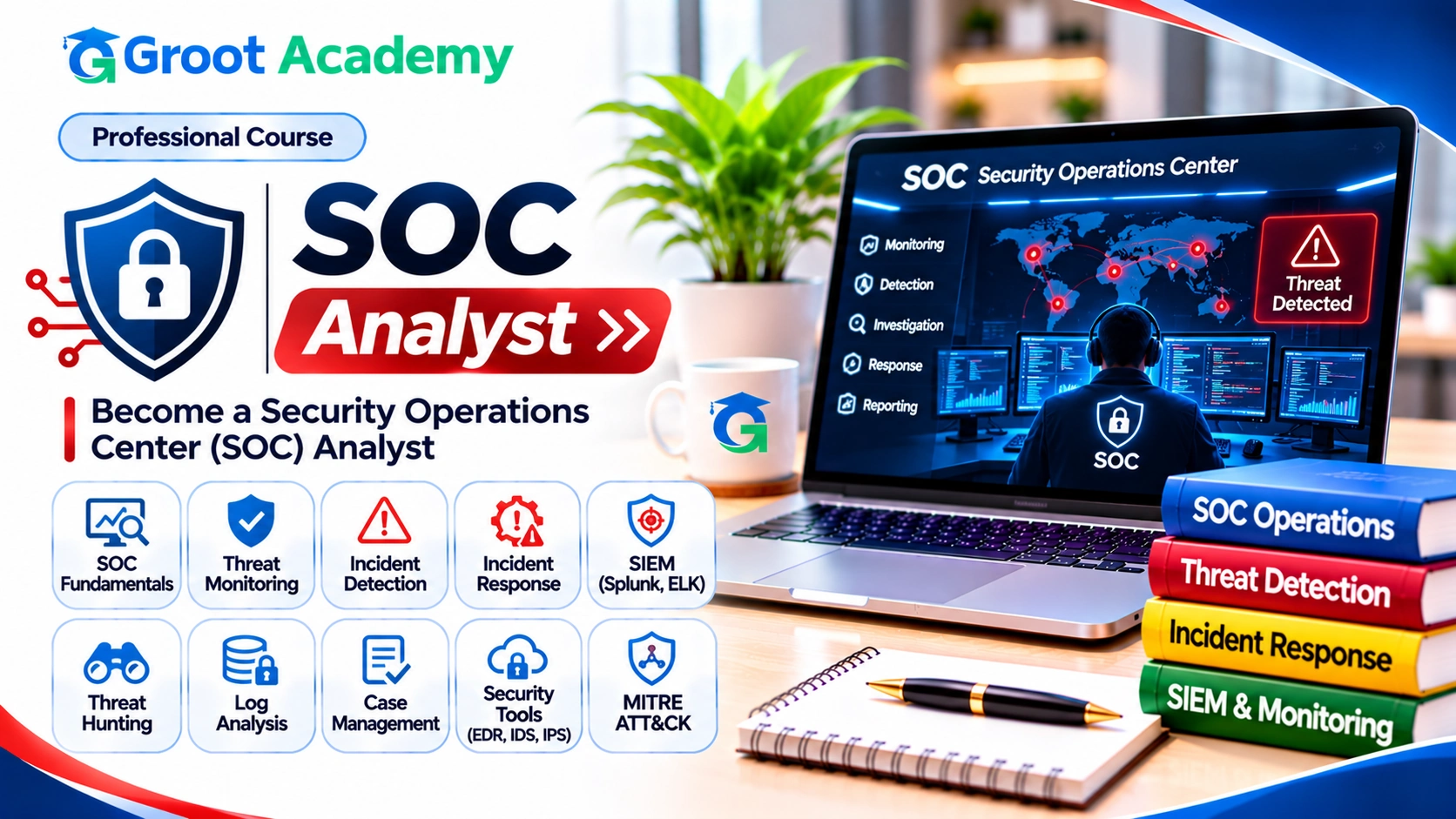
SOC Analyst
Build your foundation in SOC Analyst
Build a structured foundation in security operations: collect and investigate telemetry, triage alerts, support incident response, and document evidence and findings.
The course covers SOC operations and security monitoring, SIEM and log management, alert investigation, network and packet analysis, Windows and Linux monitoring, threat intelligence, endpoint detection, vulnerability management, MITRE ATT&CK, phishing analysis and cloud security monitoring.
Its 72 lessons cover the investigation workflow from network and host telemetry through SIEM queries, alert prioritisation, incident handling, evidence collection, reporting and interview preparation, alongside digital-forensics fundamentals and practical security-monitoring exercises.
Who can join?
Cybersecurity beginners Students interested in SOC work Learners with networking or system-administration interests IT professionals moving into cybersecurity People preparing for entry-level security operations roles
Skills and tools
Course curriculum
Explore the published learning outline below. Confirm the detailed syllabus and module coverage for your chosen batch with the course team.
Cybersecurity & SOC Fundamentals
Understand security principles and common threats, then follow SOC roles, tiers, escalation and documentation workflows.
- CIA Triad and Security Principles
- Cyber Threat Landscape
- Common Attack Vectors
- SOC Roles and Responsibilities
- SOC Tiers and Escalation
- SOC Workflow and Documentation
Networking for SOC Analysts
Build network-monitoring foundations through protocol models, addressing, traffic, common ports and security controls.
- OSI and TCP/IP Models
- IP Addressing and Subnetting
- TCP, UDP and Common Ports
- DNS and HTTP/HTTPS Traffic
- Network Devices and Security Controls
- Network Monitoring Fundamentals
Windows Security Monitoring
Review Windows users, permissions, processes, services and event logs, including authentication and PowerShell monitoring.
- Windows Processes and Services
- Users, Groups and Permissions
- Windows Event Logging
- Authentication Events
- PowerShell Security Monitoring
- Common Windows Attack Indicators
Linux Security Monitoring
Investigate Linux filesystems, users, processes, services, syslog and authentication logs using command-line techniques.
- Linux File System
- Users, Groups and Permissions
- Processes and Services
- Syslog and Authentication Logs
- Command-Line Investigation
- Linux Suspicious Activity Indicators
SIEM Fundamentals
Collect and normalise telemetry, search logs, build dashboards and correlation rules, and prioritise SIEM alerts.
- SIEM Concepts and Components
- Log Collection and Normalization
- Events, Logs and Alerts
- Search and Query Fundamentals
- Dashboards and Correlation Rules
- Alert Prioritization
Log Analysis & Alert Triage
Analyse authentication, firewall, proxy and web-server logs; distinguish true and false positives, assign severity and escalate cases.
- Authentication Log Analysis
- Firewall and Proxy Logs
- Web Server Log Analysis
- True Positive vs False Positive
- Severity and Priority
- Case Creation and Escalation
Threat Intelligence
Use threat-intelligence levels and lifecycle concepts to enrich and validate IP, domain, URL, hash and malware indicators.
- Threat Intelligence Lifecycle
- Threat Actors and Campaigns
- Strategic, Tactical and Operational Intelligence
- IP, Domain and URL Indicators
- Hashes and Malware Indicators
- IOC Enrichment and Validation
Incident Response
Follow preparation, detection, containment, eradication, recovery and lessons learned, documenting timelines, evidence and escalation.
- Preparation and Detection
- Containment and Eradication
- Recovery and Lessons Learned
- Incident Timeline Building
- Evidence Collection Basics
- Incident Reporting and Escalation
Endpoint Security & EDR
Review endpoint threats, antivirus and endpoint protection, hardening and EDR investigations of process and command-line activity.
- Endpoint Threats
- Antivirus and EPP Concepts
- Endpoint Hardening
- EDR Architecture
- Process and Command-Line Analysis
- Endpoint Alert Investigation
Vulnerability Management
Use CVSS and risk prioritisation alongside scanning, patch management, remediation, verification and reporting.
- Vulnerability Concepts
- CVSS and Risk Prioritization
- Vulnerability Scanning
- Patch Management
- Risk-Based Remediation
- Verification and Reporting
Web, Email & Cloud Security Monitoring
Investigate web attack indicators, phishing, email headers and malicious URLs, then review cloud identity, access, logs and alerts.
- Web Attack Indicators
- Phishing and Email Header Analysis
- Malicious URL Investigation
- Cloud Security Fundamentals
- Identity and Access Monitoring
- Cloud Logs and Security Alerts
SOC Analyst Tools, Reporting & Career Preparation
Connect packet analysis, threat hunting and MITRE ATT&CK mapping to case documentation, incident communication, digital-forensics fundamentals and interview preparation.
- Packet Analysis with Wireshark Concepts
- Threat Hunting Fundamentals
- MITRE ATT&CK Mapping
- Security Case Documentation
- Incident Communication
- SOC Analyst Interview Preparation
Practical SOC investigation areas
Use these exercise ideas to practise security monitoring, investigation and reporting in an authorized training lab. Document the evidence, findings and escalation steps for each investigation.
SIEM Alert Triage and Log Investigation
Use this as a practical project brief to plan, build, test and document your work.
Windows and Linux Authentication-Log Review
Use this as a practical project brief to plan, build, test and document your work.
Incident Timeline, Evidence Collection and Reporting
Use this as a practical project brief to plan, build, test and document your work.
Threat-Intelligence Indicator Enrichment
Use this as a practical project brief to plan, build, test and document your work.
Cloud Log and Identity-Monitoring Exercise
Use this as a practical project brief to plan, build, test and document your work.
Frequently asked questions
Quick answers about learning, projects, batches and the next step at Groot Academy.
What does the SOC Analyst course cover?
The curriculum includes security monitoring, SIEM, log analysis, alert triage, incident response, threat intelligence, endpoint security, vulnerability management, cloud monitoring and reporting.
Does it include Windows and Linux security logs?
Yes. The curriculum covers Windows event and authentication logs, Linux syslog and authentication logs, and suspicious-activity indicators.
Are threat intelligence and incident response included?
Yes. The curriculum includes indicator enrichment and validation, incident preparation through recovery, evidence collection, reporting and escalation.
Does the course include cloud monitoring and threat hunting?
Yes. The curriculum includes cloud security, identity and access monitoring, cloud logs, threat hunting and MITRE ATT&CK mapping.
Who is this course for?
Cybersecurity beginners Students interested in SOC work Learners with networking or system-administration interests IT professionals moving into cybersecurity People preparing for entry-level security operations roles
How can I confirm fees, duration and batch timings?
Contact Groot Academy for the current syllabus, fees, duration and available learning modes before enrolling. These details depend on the selected course and batch.
What will I study in the SOC Analyst course?
Build a structured foundation in security operations: collect and investigate telemetry, triage alerts, support incident response, and document evidence and findings.
Which skills and tools are covered in SOC Analyst?
The published learning outline includes Understand security principles, common threats and SOC roles and escalation, Interpret network traffic and monitoring signals, Review Windows event logs, Linux authentication logs and process activity, Collect and normalize events, search logs and investigate SIEM alerts, Prioritize findings and distinguish true positives from false positives, Use threat intelligence and validate indicators. See the skills section for the complete current outline and confirm the batch syllabus before joining.
What topics are included in the SOC Analyst curriculum?
The listed modules include Cybersecurity & SOC Fundamentals, Networking for SOC Analysts, Windows Security Monitoring, Linux Security Monitoring, SIEM Fundamentals. Read the curriculum section for details; the delivery sequence can vary by batch.
What practical projects can I explore during SOC Analyst?
The page lists practice ideas such as SIEM Alert Triage and Log Investigation, Windows and Linux Authentication-Log Review, Incident Timeline, Evidence Collection and Reporting, Threat-Intelligence Indicator Enrichment. Ask the course team which project activities are included in your particular batch.
How can I use SOC Analyst projects in my portfolio?
Document the problem, the tools you used, the decisions you made and the result. Include working examples or a repository where appropriate, and explain your own contribution clearly.
Can a beginner start learning SOC Analyst?
Compare the course prerequisites and learning outline with your current skills. Beginners can ask the team which foundations to practise first and whether the next batch is suitable for their level.
What should I prepare before a SOC Analyst batch?
Review any stated prerequisites, plan regular practice time and ask which device, software and setup are required for the current batch.
Are online or classroom batches available for SOC Analyst?
Delivery mode depends on the active course batch. Contact Groot Academy to check the current online, offline or hybrid options instead of assuming every mode is available.
How can I check the latest SOC Analyst syllabus?
Review the published curriculum on this page and request the latest batch-specific outline from the course team. Topics or sequencing can change as the program is updated.
How much practice time should I plan for SOC Analyst?
Set aside consistent time to review lessons, practise exercises and work on projects. The appropriate weekly commitment depends on your experience, selected batch and course scope.
Will I receive a certificate after SOC Analyst?
Ask the course team about certificate availability, issuer, completion criteria and verification process for the specific batch. Do not assume a certificate is automatic for every program.
Does taking SOC Analyst guarantee a job?
No course alone guarantees employment. A strong learning plan combines technical understanding, independent projects, communication, interviews and suitable opportunities.
Can I ask about assignments and assessments before joining SOC Analyst?
Yes. Request the current batch learning plan and ask how exercises, project reviews, feedback and progress checks are organised.
What happens if I miss a SOC Analyst class?
Make-up lessons, recordings and attendance rules depend on the batch policy. Confirm these arrangements directly before paying or enrolling.
How do I enquire or enrol in SOC Analyst?
Use the enquiry form on the course page or contact Groot Academy. First confirm eligibility, current syllabus, schedule, fees and any applicable terms.
Ready to discuss SOC Analyst?
Ask the course team about syllabus coverage, current batch timings, fees, duration and learning modes before you decide.
Continue exploring
Read the SOC Analyst career guide